

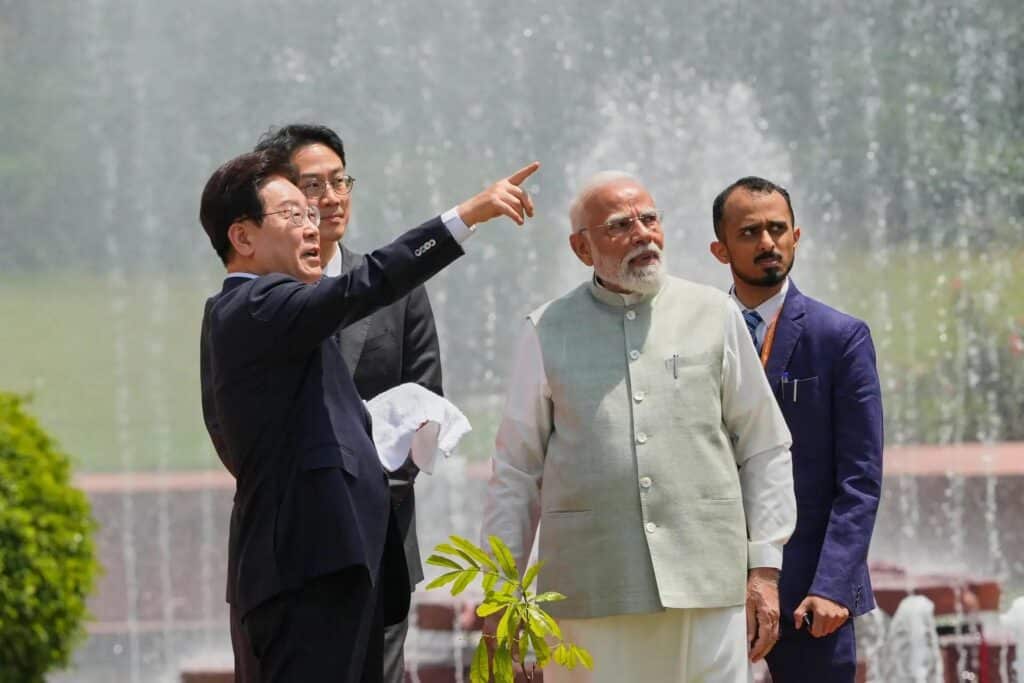
The visit of Lee Jae-myung to India has brought renewed focus on expanding bilateral economic engagement, with both sides outlining plans to scale up investment, strengthen industrial cooperation and deepen collaboration in emerging sectors.
Lee met Narendra Modi in New Delhi for wide-ranging talks covering trade, technology and supply chains. The discussions form part of ongoing efforts by India and South Korea to broaden their partnership at a time of shifting global economic patterns.
According to the Ministry of External Affairs, the South Korean president expressed surprise at the relatively limited presence of Korean firms in India. Officials said Lee noted that only around 700 South Korean companies are currently operating in the country and conveyed interest in seeing that number increase significantly, potentially by up to ten times.
“We discussed issues Korean companies want resolved,” the MEA said following the talks, indicating that investment-related concerns were a central part of the engagement.
Investment concerns and business environment
The discussions highlighted longstanding concerns among South Korean businesses operating in India. These include regulatory procedures, taxation issues and challenges linked to land acquisition and compliance requirements.
Indian officials acknowledged that addressing these concerns would be important for expanding the presence of Korean firms. The engagement at the leadership level reflects a focus on resolving operational issues that have affected the pace of investment.
South Korean companies have maintained a steady presence in India across key sectors. Major firms such as Samsung Electronics, Hyundai Motor Company and LG Electronics operate large manufacturing and sales networks in the country. Their investments span electronics, automobiles and consumer goods, with production facilities serving both domestic and export markets.
Officials indicated that future expansion is expected to involve a broader range of companies, including small and medium enterprises from South Korea.
Focus on technology and industrial cooperation
In addition to investment flows, both sides discussed cooperation in technology driven sectors. Artificial intelligence, advanced manufacturing and digital systems were among the areas identified for closer collaboration.
India’s digital infrastructure and South Korea’s industrial base were highlighted as complementary strengths. Officials said the two countries are examining ways to enhance cooperation in research, development and deployment of new technologies.
Maritime and shipping cooperation also featured in the discussions. With supply chains undergoing adjustments globally, both sides reviewed opportunities to improve logistics coordination and maritime connectivity. South Korea’s expertise in shipbuilding and India’s strategic location were noted during the talks.
Trade and economic framework
India and South Korea are linked through a Comprehensive Economic Partnership Agreement that governs trade and investment flows. Officials from both sides acknowledged that there is scope to improve the utilisation of the agreement.
The discussions included ways to address trade barriers and facilitate smoother market access for businesses. Increasing bilateral trade volume remains a priority alongside expanding investment.
India has introduced a series of policy measures aimed at strengthening domestic manufacturing. These include production linked incentive schemes designed to attract foreign investment and encourage export oriented production. Officials said such initiatives could support greater participation by South Korean firms.
Strategic and regional context
The visit also takes place in a broader regional context where economic cooperation is increasingly linked with supply chain resilience and diversification. India and South Korea have both emphasised the importance of stable and reliable economic partnerships.
While the focus of the visit remained economic, officials noted that closer engagement contributes to wider regional stability in trade and manufacturing networks. Both countries are part of a larger Indo Pacific framework where economic partnerships play a central role.
Expanding corporate presence
The reference to increasing the number of South Korean companies in India formed a key part of the discussions. Officials said the goal is not limited to large corporations but extends to creating conditions that enable a wider base of firms to enter the Indian market.
Efforts to simplify regulatory processes and improve ease of doing business have been identified as important steps in this direction. Indian authorities have undertaken reforms in recent years aimed at reducing compliance burdens and improving transparency.
South Korean companies have also expanded their operations beyond major metropolitan areas into industrial corridors and emerging manufacturing hubs. This trend is expected to continue as infrastructure development progresses.
Implementation and follow up
Officials from both countries indicated that the outcomes of the visit would be followed up through existing institutional mechanisms. Sector specific dialogues and working groups are expected to take forward discussions on investment and technology cooperation.
The engagement between Lee and Modi reflects continuity in bilateral relations, with both sides maintaining regular high level contacts. Economic cooperation remains a central pillar of the partnership.
The focus on increasing the number of Korean companies in India underscores the scale of ambition in the relationship. At the same time, officials have pointed to the need for sustained policy coordination to translate discussions into concrete outcomes.
Next steps
The visit of President Lee Jae myung has reinforced the emphasis on expanding India South Korea economic ties through investment, technology and industrial collaboration. The discussions highlighted both the opportunities and the existing challenges in scaling up engagement.
With a target of significantly increasing the presence of South Korean companies in India, the talks have set a direction for future cooperation.


