

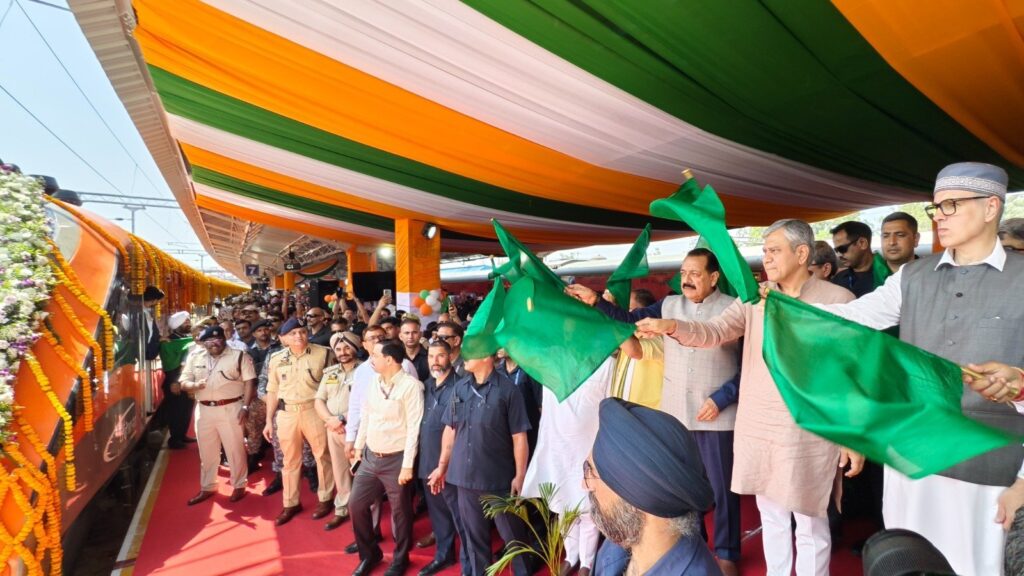
The extension of the Vande Bharat Express connecting Srinagar directly with Jammu Tawi marks a significant milestone in India’s railway expansion into the Himalayan region. Flagged off by Ashwini Vaishnaw on 30 April 2026, the service establishes a seamless, high-speed rail corridor between the Kashmir Valley and Jammu, the region’s primary railway gateway. The development follows decades of engineering work under the Udhampur–Srinagar–Baramulla Rail Link, widely regarded as one of the most complex railway projects undertaken in the country. For years, connectivity to the Valley depended heavily on road transport vulnerable to landslides, snowfall, and seasonal disruptions. This new direct rail link changes that equation, offering a reliable, all-weather alternative.
With regular operations scheduled to begin from 2 May, the service is expected to significantly reduce travel time, improve passenger convenience, and strengthen economic and administrative integration between Jammu and Srinagar. Officials describe the extension as more than a transport upgrade, calling it a structural shift that brings modern rail infrastructure into one of India’s most geographically challenging regions while integrating it more closely with the national network.
Flag-Off
The inaugural service was flagged off from Jammu Tawi Railway Station, marking the formal expansion of the Vande Bharat route into a full Srinagar–Jammu corridor. The event signals the transition from a limited Srinagar–Katra service to a broader, integrated regional link that connects key urban and transit points without interruption.
Railway Minister Ashwini Vaishnaw underscored the importance of the development in his official remarks, stating, “This direct service between Srinagar and Jammu is a major step in strengthening connectivity and bringing the benefits of modern rail transport to the people of Jammu and Kashmir.” He further noted that the government’s focus remains on delivering infrastructure that is both efficient and resilient, particularly in regions where terrain has historically limited access.
Officials clarified that while the ceremonial flag-off took place on 30 April, commercial operations will commence from 2 May. This phased rollout ensures operational readiness, including scheduling, staffing, and passenger services, ahead of anticipated high demand during the upcoming travel season.
Corridor
The extension creates a single uninterrupted rail corridor between Srinagar and Jammu, eliminating the need for passengers to change trains at Katra. Operating along the Jammu–Baramulla Rail Line, the service integrates multiple previously completed segments into one continuous route through the Himalayan landscape.
Railway authorities highlighted the broader implications of this development, stating, “The introduction of a direct, uninterrupted service is expected to significantly enhance ease of travel for pilgrims, traders and tourists while ensuring reliable connectivity throughout the year.” The route is expected to serve a wide range of passengers, including those travelling to the Vaishno Devi Temple, one of the country’s most visited pilgrimage sites.
The inclusion of Jammu Tawi as a terminal point is particularly significant. As the largest railway hub in Jammu and Kashmir, it functions as the primary gateway connecting the region to major cities across India. The extension therefore removes a key logistical bottleneck, enabling smoother and more efficient long-distance travel into the Valley.
Time and Capacity
The direct Srinagar–Jammu journey is expected to take approximately five hours, marking a substantial improvement over road travel, which can often extend well beyond this duration depending on weather and traffic conditions. The reduction in travel time is likely to enhance not only passenger convenience but also scheduling reliability, especially during winter months when highways are frequently disrupted.
The extension also brings a significant increase in train capacity. The Vande Bharat configuration has been expanded from 8 coaches to 20 coaches, reflecting strong passenger demand observed since the earlier phase of operations. Officials explained the decision, stating, “The increase in coach capacity reflects the growing popularity of the Vande Bharat service in the region and is aimed at accommodating higher passenger volumes without compromising comfort.”
The enhanced capacity is expected to reduce waiting lists, particularly during peak tourism and pilgrimage seasons. In addition to increased seating, passengers will continue to benefit from modern onboard features, including improved seating ergonomics, onboard catering, and enhanced safety systems, maintaining the premium positioning of the Vande Bharat service.
Engineering
The service runs on infrastructure developed under the Udhampur–Srinagar–Baramulla Rail Link, a project that has required extensive tunnelling and bridge construction through some of the most challenging terrain in the Himalayas. The corridor represents years of coordinated engineering effort aimed at overcoming geological, climatic, and logistical constraints.
Among the most notable structures along the route are the Chenab Rail Bridge and the Anji Khad Bridge. The Chenab Bridge, the world’s highest railway arch bridge, stands as a landmark achievement in civil engineering, while the Anji Bridge represents India’s first cable-stayed railway bridge, designed to support rail operations in difficult mountainous conditions.
Following the flag-off, Ashwini Vaishnaw reviewed these critical infrastructure sites. Officials noted, “These engineering structures are central to ensuring safe, reliable and uninterrupted rail connectivity in a region defined by complex terrain.”
The Vande Bharat trains deployed on this route have also been adapted for extreme weather. Equipped with heating systems, insulated components, and enhanced operational features, they are designed to function effectively in sub-zero temperatures, ensuring year-round service reliability in the Kashmir Valley.
Impact
The extension of the Vande Bharat service is expected to generate wide-ranging economic, social, and strategic benefits. Improved rail connectivity is likely to boost tourism in the Kashmir Valley by making travel faster, safer, and more predictable. The service also simplifies pilgrimage journeys, particularly for those visiting key religious sites in the region.
Officials emphasised the broader developmental implications, stating, “Enhanced rail connectivity between Jammu and Srinagar will contribute to economic growth, improve accessibility, and strengthen integration within the region.” The corridor connects Jammu, the winter capital, with Srinagar, the summer capital, facilitating smoother administrative movement and coordination.
From a logistical perspective, the railway provides a reliable alternative to road transport, which is often affected by adverse weather conditions such as snowfall and landslides. This improved reliability is expected to support local businesses, enable better movement of goods, and enhance overall regional mobility.
Strategically, the project reflects a sustained focus on infrastructure-led development in geographically sensitive and challenging areas. By strengthening connectivity in Jammu and Kashmir, the railway network contributes to long-term regional stability and economic integration, positioning rail transport as a central component of future growth.
Outlook
The launch of the direct Srinagar–Jammu Vande Bharat Express marks the culmination of decades of planning, engineering innovation, and phased execution. By transforming a fragmented, multi-stage journey into a seamless rail experience, the extension redefines connectivity in Jammu and Kashmir.
With reduced travel time, expanded capacity, and modern infrastructure, the service is set to play a central role in shaping the region’s mobility and economic landscape. As regular operations begin in May 2026, the corridor stands as a significant step towards integrating the Kashmir Valley more closely with India’s national railway network, offering a reliable, efficient, and year-round transport solution in one of the country’s most challenging terrains.


