

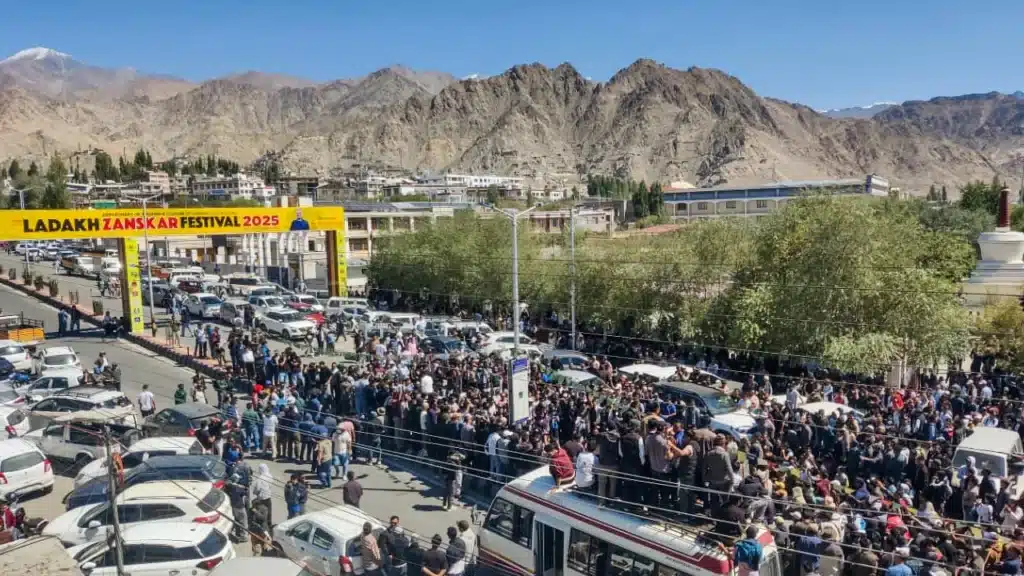
Leh protests: deaths, injuries and security clampdown
Leh, the capital of Ladakh, witnessed its deadliest unrest in years as demonstrations for Ladakh statehood and inclusion under the Sixth Schedule turned violent on 24–25 September 2025. At least four people were killed and more than 70 injured after protesters clashed with police and paramilitary forces. Eyewitnesses reported stone-pelting, arson, and baton charges, while officials confirmed curfews were imposed in Leh and Kargil, alongside strict restrictions on gatherings. Shops, schools, and government offices remained closed as the administration moved to restore calm.
Security forces now patrol sensitive zones, and checkpoints have been established across the Union Territory. Officials described the situation as “under control” but tense, with residents urged to stay indoors.
Why the Leh protests erupted: statehood, Sixth Schedule and local grievances
The anger in Ladakh has been simmering since August 2019, when Ladakh was delinked from Jammu & Kashmir and made a Union Territory of direct rule of the Centre. When first announced, both the bureaucratic change and new iteration of Ladakh was welcomed by the local population as it enabled a distinct regional identity. But locals began to air the political implications of less representation, less security for land and jobs, felt at risk of marginalization, all of which trigger their anger.
For years, civil society groups such as the Leh Apex Body (LAB) and the Kargil Democratic Alliance (KDA) have pressed for:
- Full statehood for Ladakh
- Sixth Schedule inclusion, granting constitutional protections over land, environment, and tribal rights
- Greater local autonomy in governance and decision-making
The latest protests were triggered by the collapse of hunger strikers led by climate activist Sonam Wangchuk, whose campaign drew significant youth participation. His call for safeguarding Ladakh’s fragile ecology and tribal identity resonated widely, escalating peaceful sit-ins into mass rallies.
Violence on the streets: torched vehicles, damaged offices and arrests
As unrest grew, certain areas of Leh saw violence erupt. Protesters are said to have set a police/CRPF vehicle ablaze, vandalised a local BJP office, and clashed with security forces. Videos circulating on social media depicted tear gas shelling and baton charges. Officials confirmed multiple arrests, although the exact number was unknown.
Residents insisted the police used excessive force against unarmed protesters, while officials maintained police would not have responded if the mob had not turned violent. The escalation in damage has fueled even greater anger within the public, and widened the trust deficit between residents and the administration.
Law enforcement and CBI probe: the Sonam Wangchuk angle
Amid unrest, the Central Bureau of Investigation (CBI) launched an inquiry into alleged violations of the Foreign Contribution Regulation Act (FCRA) by an institution linked to Sonam Wangchuk. Government officials maintain this is a routine probe, but supporters see it as an attempt to discredit the activist and weaken the movement. Wangchuk, who has become the symbolic face of Ladakh’s autonomy struggle, has denied all allegations, framing the probe as politically motivated.
Political reactions and accountability demands
The killings have sparked political outrage. The Leh Apex Body and Kargil Democratic Alliance jointly condemned the violence, demanding an impartial, time-bound judicial inquiry. Opposition leaders accused the Centre of mishandling Ladakh’s governance and ignoring legitimate concerns, while BJP leaders labelled the unrest “politically motivated.”
Observers warn that mishandling of the crisis could destabilize the strategically vital region, which borders both China and Pakistan. Ladakh’s geostrategic importance — especially after the 2020 Galwan Valley clash — makes its stability crucial for India’s security calculus.
What comes next: talks, probes and Ladakh’s uncertain future
Talks between the Centre and Ladakh leaders are set for early October, with statehood and Sixth Schedule inclusion as the main issues. A CBI probe into Sonam Wangchuk’s institution and an inquiry into protest deaths will shape public opinion. Analysts warn that without credible accountability and dialogue, mistrust in Leh could deepen further.


