

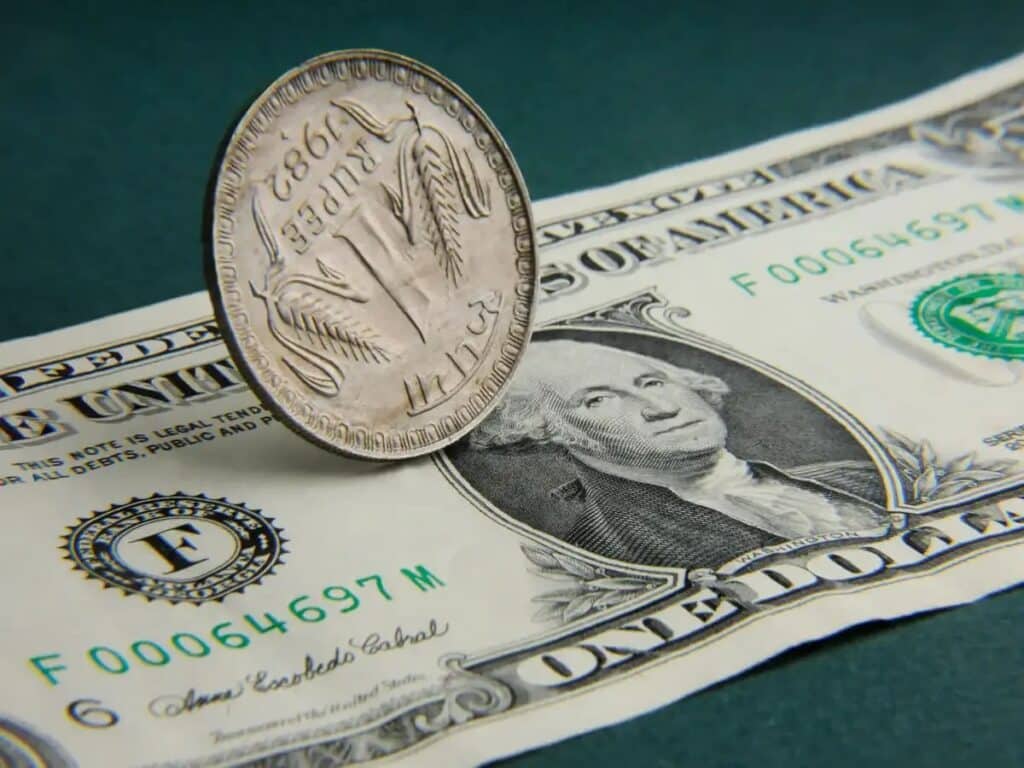
Rupee has plunged to a historic low, breaching the ₹90-per-dollar mark for the first time and sending ripples across India’s financial markets. Opening at 90.07 and dipping further to 90.14 in early trade, the currency’s fall reflects persistent capital outflows, a stressed trade environment and an increasingly tight global monetary landscape. This milestone has intensified discussions around inflation, import-led pressures and India’s broader macroeconomic path, drawing the close watch of policymakers, traders and industry leaders. With the currency now among Asia’s weakest performers this year, the depreciation highlights the complex interplay of global volatility and domestic economic adjustments.
Record Low, Rising Concerns
The slide past ₹90 comes after weeks of gradual weakening, during which the rupee hovered near its previous lows in the high-89 range. The cumulative depreciation this year now exceeds 5 percent, marking one of the steepest annual declines in recent times. Traders report that the fall has been sharper than expected, accelerated by heightened dollar demand from importers and caution among exporters who are holding back conversions in anticipation of further weakening. Market sentiment has turned cautious, with businesses recalibrating their foreign-currency strategies amid unpredictable movements.
Capital Outflows Intensify Pressure
One of the strongest forces behind the rupee’s fall has been sustained foreign portfolio outflows from India’s equity and debt markets. Investors have been reallocating funds to safer assets, driven by strong economic data emerging from the United States and evolving policy expectations from the US Federal Reserve. This shift has weakened investment inflows into emerging markets. Simultaneously, muted foreign direct investment and lower external borrowing have contributed to a shortfall in dollar liquidity, widening the gap between supply and demand.
The result is a currency market heavily tilted toward dollar strength, where even moderate domestic pressures result in disproportionate depreciation.
Trade Deficit and Dollar Demand Weigh on the Rupee
India’s widening trade deficit has added momentum to the rupee’s decline. High import dependency in sectors such as crude oil, electronics, machinery and industrial components has pushed up dollar requirements. At the same time, some exporters are delaying receipts, expecting more favorable exchange rates later.
Compounding this is uncertainty surrounding potential trade agreements and tariff policies, which has dampened exporter confidence. The imbalance between strong importer demand and cautious exporter supply has intensified the downward pressure on the rupee.
RBI Maintains Measured Intervention
The Reserve Bank of India has intervened in the spot and forward markets, but its approach remains consistent: prevent excessive volatility without defending any fixed exchange rate. The central bank continues to utilize its substantial foreign-exchange reserves prudently, smoothing extreme fluctuations rather than reversing market trends.
Economists describe the rupee as functioning as a “shock absorber” in times of global instability. Rather than abrupt correction cycles, the currency is steadily adjusting to the world’s shifting financial landscape. This strategy, while moderating panic, also leaves room for further weakness if external pressures persist.
Government’s Official Response
The government has projected confidence despite the historic slide. Senior officials from the Ministry of Finance emphasize that India’s macroeconomic fundamentals remain stable.
Chief Economic Adviser V. Anantha Nageswaran stated that the weakening rupee is “not hurting inflation or exports in a significant way” and that the situation is being closely monitored. He added that India’s strong growth outlook, healthy fiscal position and ample foreign-exchange reserves provide the necessary buffer to manage currency fluctuations.
Nageswaran also underlined that the rupee’s movement must be viewed within a global context, where several emerging-market currencies are facing similar pressures. His remarks reflect the government’s position that the depreciation is a manageable phase rather than a sign of structural distress.
Sector-Wise Impact in India

Import-Heavy Industries Brace for Costs
Sectors such as energy, electronics, aviation, automotive components and pharmaceuticals are expected to feel the immediate impact of a weaker rupee. Higher import costs may gradually feed into retail inflation. Companies reliant on foreign raw materials may face margin pressures unless they increase prices or adjust procurement strategies. Consumers planning overseas travel or education may also encounter higher expenses as the rupee’s buying power weakens.
Exporters See Mixed Outcomes
Export-oriented sectors such as IT services, pharmaceuticals and engineering may benefit from better rupee realisations on dollar earnings. However, the gains may not be uniform. Companies with extensive hedging or long-term contracts may see limited immediate advantage. Exporters also remain cautious due to global demand concerns and tariff uncertainties in major markets.
Financial Markets and Investor Sentiment
The stock market has been sensitive to currency volatility. Continued foreign selling has added pressure on indices, affecting sentiment among domestic institutional investors as well. Currency-dependent companies, particularly those with unhedged foreign debt, are facing rising hedge costs as forward premiums have increased. The financial sector is closely monitoring these developments to manage risks effectively.
What Will Influence the Rupee Next
Several key variables will shape the rupee’s direction in the coming weeks:
- Foreign Institutional Investor flows: Continued outflows will weigh heavily; any inflow reversal could ease pressure.
- Crude oil price movement: A rise in global oil prices could significantly worsen India’s import bill and weaken the currency further.
- Trade agreement progress: Developments in trade negotiations will influence both sentiment and actual export flows.
- Global monetary policy: Decisions by major central banks, especially the US Federal Reserve, will remain critical.
- RBI’s intervention pattern: A shift toward stronger intervention could stabilise near-term volatility.
- Domestic inflation and growth metrics: Fresh data will play a role in shaping interest-rate expectations and currency reactions.
A Critical Moment for the Rupee
The rupee’s fall past ₹90 is a defining moment, highlighting the intersection of global turbulence and domestic currency dynamics. While the psychological impact is substantial, experts agree that India’s underlying fundamentals remain sound. The country’s robust economic growth, strong banking system and sizable reserves provide resilience, even as short-term pressures intensify.
What happens next will depend on a delicate balance of policy decisions, global market behavior and domestic economic adjustments. For now, India enters a period of heightened currency vigilance one where measured policy, prudent market behavior and steady economic fundamentals will play key roles in navigating the turbulence ahead.


