

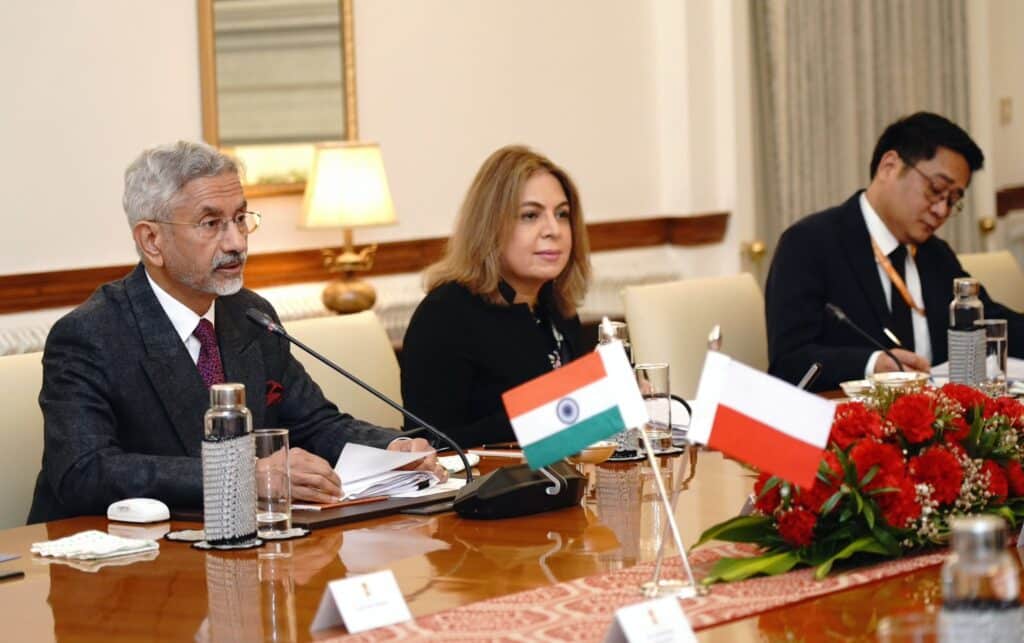
India’s External Affairs Minister S. Jaishankar issued a firm diplomatic warning to Poland during bilateral talks in New Delhi, urging Warsaw to adopt zero tolerance for terrorism and cautioning against any engagement that could support terrorist infrastructure in India’s neighbourhood.
The remarks were made during a meeting with Polish Foreign Minister Radosław Sikorski, who was on an official visit to India shortly after travelling to Pakistan. While both sides highlighted expanding trade and strategic cooperation, the discussions also exposed differences over security priorities, India’s energy ties with Russia, and the broader geopolitical impact of the war in Ukraine.
Direct Warning
Opening the talks, Jaishankar set out India’s expectations in clear terms.
“We expect our partners to show zero tolerance for terrorism and not help fuel terrorist infrastructure in our neighbourhood,” he said, according to official statements released after the meeting.
The reference was widely seen as linked to Sikorski’s recent engagement with Pakistan, a country India has repeatedly accused of supporting cross-border terrorism. Indian officials have long maintained that militant groups operating from Pakistani territory continue to pose a threat to India’s security.
Jaishankar’s remarks were delivered publicly at the start of the talks, an approach Indian officials said reflected the importance New Delhi places on counter-terrorism in its external relations.
Pakistan Context
Although Pakistan was not explicitly named in all public remarks, Indian officials said the context of the warning was clear.
India has consistently objected to international statements and joint declarations that refer to regional security or Kashmir without addressing terrorism. New Delhi argues that such formulations weaken global counter-terrorism efforts and overlook the security challenges it faces.
India has raised these concerns repeatedly at multilateral forums, including the United Nations, and in bilateral engagements with foreign governments. Pakistan has denied the allegations and says it does not support militant groups.
Public Positioning
The tone and timing of Jaishankar’s remarks marked a departure from earlier diplomatic practice, where sensitive security concerns were often conveyed privately.
In recent years, India has increasingly raised such issues openly with foreign partners. Officials say this reflects a broader effort to ensure clarity and consistency in international engagement on terrorism.
The approach has been visible in India’s interactions with several Western and European countries, particularly when discussions involve security cooperation or regional stability in South Asia.
Poland’s Reply
Sikorski responded by stressing Poland’s opposition to terrorism and support for international cooperation on security.
“We agree that terrorism, including cross-border terrorism, remains a serious threat,” he said, according to officials present at the meeting.
The Polish foreign minister said Warsaw does not support terrorism in any form and backs multilateral efforts to counter extremist violence. He did not indicate any change in Poland’s engagement with Pakistan following the talks.
Polish officials said Warsaw maintains diplomatic relations with multiple countries in South Asia as part of its broader foreign policy and regional engagement.
Ukraine Focus
The discussions also covered differences over the war in Ukraine and its economic consequences.
Sikorski raised concerns about India’s continued purchases of Russian crude oil amid Western sanctions imposed after Moscow’s invasion of Ukraine. He warned that evolving tariff regimes and compliance measures could lead to trade disruption.
Poland has been among Ukraine’s strongest supporters within the European Union and NATO, backing sanctions against Russia and calling for sustained international pressure on Moscow.
India Responds
Jaishankar rejected the criticism, describing the targeting of India over its energy imports as “unfair and unjustified”.
He said India’s energy decisions were driven by national requirements and market conditions. Indian officials have repeatedly noted that European countries were among the largest buyers of Russian energy before the war in Ukraine.
India has maintained that its purchases of Russian oil are legal and conducted within prevailing global frameworks.
Energy Security
Indian officials say affordable and reliable energy remains a priority for the country, which has a large population and a fast-growing economy.
New Delhi has argued that it cannot compromise its energy security or economic stability because of external political pressure. India has also said it supports diplomatic efforts aimed at ending the conflict in Ukraine.
Poland, which has reduced its dependence on Russian energy since the start of the war, has continued to press for tougher international action against Moscow.
Trade Growth
Despite the candid exchanges, both sides highlighted the steady expansion of economic ties.
Bilateral trade between India and Poland has reached close to $7 billion, according to official figures. Discussions during Sikorski’s visit focused on increasing cooperation in defence manufacturing, clean energy, digital technology and innovation.
Polish companies have expressed interest in India’s expanding market, while Indian firms are exploring investment opportunities in Central and Eastern Europe.
Strategic Partnership
India and Poland elevated their relationship to a strategic partnership in recent years, reflecting closer political and economic engagement.
Officials said cooperation had expanded in areas including science and technology, education, defence collaboration and business-to-business exchanges. Clean energy, including renewable technologies, was also discussed during the talks.
Both sides said existing institutional mechanisms would be used to advance cooperation.
European Context
Poland’s engagement with India forms part of New Delhi’s broader outreach to the European Union and its member states.
India and the EU are working to strengthen trade and investment ties while expanding cooperation on global challenges. At the same time, Indian officials say security concerns, particularly terrorism, remain central to India’s foreign policy discussions with European partners.
No Joint Outcome
No joint statement was issued following the meeting, and no formal agreements were announced.
Officials from both sides described the talks as frank and constructive, covering bilateral, regional and global issues. They said discussions would continue through established diplomatic channels.
Ongoing Engagement
The meeting highlighted a relationship that continues to expand while accommodating differences on key geopolitical and security issues.
Jaishankar’s remarks reaffirmed India’s position that counter-terrorism remains a central element of its international engagements.
Both sides said dialogue would continue as part of the India–Poland strategic partnership.


