

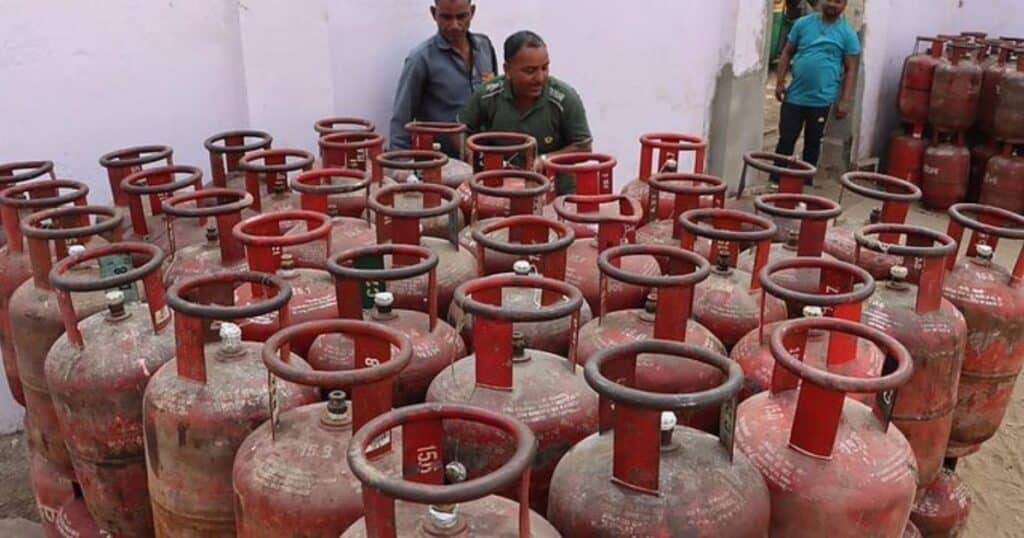
India is facing rising concerns over the availability of commercial LPG cylinders as tensions in West Asia begin to ripple through global energy supply chains. Congress leader Sachin Pilot has urged the government to address the issue in Parliament, warning that supply disruptions and rising prices could soon affect businesses and households across the country.
Reports from several cities suggest that commercial LPG cylinders used by hotels, restaurants and street vendors are becoming harder to obtain. Industry associations say deliveries have slowed and prices are rising in some markets, creating uncertainty for thousands of small businesses that depend on cooking gas for daily operations.
While the government has said household LPG supply remains stable, the situation has revived debate about India’s heavy dependence on imported fuel and the vulnerability of its energy supply chain during geopolitical crises.
Pilot Raises Alarm
Sachin Pilot has called for a detailed discussion in Parliament on the emerging LPG supply concerns.
Speaking to reporters, he said that disruptions caused by the conflict in the Gulf region were expected, but India must be prepared with contingency plans to handle such shocks.
Pilot pointed out that India imports about 83 percent of its oil and fuel requirements. Because of this high dependency, any disruption in global supply routes can quickly translate into domestic shortages or price spikes.
He warned that if supply constraints continue, the burden will fall directly on the common citizen, particularly the middle class and small business owners who rely heavily on commercial LPG cylinders.
Pilot said the government should explain what alternative arrangements are being made to ensure uninterrupted fuel supply.
Gulf Conflict Impact
The concerns come amid the ongoing tensions in West Asia involving Iran, Israel and the United States.
Energy markets are particularly sensitive to disruptions in the Strait of Hormuz, one of the world’s most critical energy corridors.
Nearly one fifth of the global oil and liquefied petroleum gas trade passes through this narrow maritime route. Any security risk or disruption to shipping traffic in this area can quickly affect energy supplies across Asia.
India imports a significant portion of its LPG from Gulf producers such as Saudi Arabia, Qatar and the United Arab Emirates. Because of this reliance, tensions in the region can directly influence supply flows and market prices.
India’s LPG Dependence
India’s LPG consumption has increased sharply over the past decade as urbanisation, rising incomes and government welfare schemes expanded the use of cooking gas across the country.
The country consumes more than 29 million tonnes of LPG every year. Domestic production meets only part of this demand, forcing India to import nearly 60 percent of its LPG requirement.
At the same time, India imports close to 90 percent of its crude oil consumption, making it one of the world’s most import dependent major economies when it comes to energy.
Analysts say this dependence leaves India vulnerable whenever geopolitical tensions disrupt global supply routes.
Hotels Face Disruption
The hospitality sector has been among the first to feel the impact of tightening LPG supplies.
Hotels, restaurants and catering services rely heavily on 19 kilogram commercial LPG cylinders for cooking.
Industry groups in cities such as Bengaluru, Mumbai, Chennai, Delhi and Kolkata say deliveries have slowed in recent days.
Restaurant operators say the uncertainty has forced many establishments to scale down operations. Some kitchens have begun trimming their menus and temporarily removing dishes that require high gas consumption or long cooking times.
Industry representatives say these reduced offerings are effectively skeletal menus designed to conserve gas until supplies stabilise.
Kitchens Running Low
Restaurant associations say many kitchens cannot maintain large LPG reserves because of safety regulations governing gas storage.
As a result, most establishments depend on regular deliveries of commercial cylinders to keep operations running.
With supply becoming uncertain in some cities, restaurant owners say they have had to manage cooking schedules carefully to stretch the available gas.
Small eateries, tea stalls and street food vendors are particularly vulnerable because their businesses operate on thin profit margins and rely on daily gas supply to function.
Even a brief disruption in deliveries can force some vendors to suspend operations temporarily.
Domestic LPG Prioritised
One of the key factors behind the commercial LPG shortage is the government’s decision to prioritise household cooking gas supply.
Oil marketing companies have reportedly been directed to ensure that domestic LPG cylinders used in homes remain available without disruption.
While this policy protects household consumers, it has reduced the number of cylinders available for commercial users such as restaurants, catering businesses and small food vendors.
Industry groups say this shift in distribution has added pressure on the hospitality sector at a time when global supply conditions are already uncertain.
Government Measures
The central government has attempted to reassure the public that there is no immediate shortage of household cooking gas.
Officials say domestic refineries have been asked to increase LPG output to offset supply disruptions from overseas shipments.
Production at several refineries has reportedly been raised by around 10 percent as part of emergency supply measures.
Authorities have also formed a monitoring group comprising officials from energy ministries and oil companies to track the situation and coordinate supply distribution.
India is also exploring additional LPG imports from alternative suppliers outside the Gulf region to stabilise supply.
Economic Ripple Effects
Energy disruptions rarely remain confined to a single sector.
Commercial LPG is widely used not only in restaurants but also in bakeries, catering units and small food processing businesses.
If cylinder prices continue to rise or supply becomes constrained, many businesses may pass the increased costs to consumers.
That could eventually translate into higher food prices in urban areas, adding to existing inflationary pressures.
Economists warn that energy shocks often create wider ripple effects across transportation, manufacturing and food supply chains.
Energy Security Debate
The emerging LPG supply concerns have once again highlighted the need for a stronger long term energy security strategy.
Experts say India must diversify its energy import sources and strengthen strategic reserves to reduce exposure to geopolitical risks.
India has expanded renewable energy capacity significantly in recent years, with solar and wind power growing rapidly.
However, fossil fuels continue to dominate the country’s energy mix, meaning disruptions in global oil and gas markets will continue to affect domestic supply conditions.
Political Debate Intensifies
With Parliament currently in session, the LPG issue is expected to become a major topic of political debate.
Opposition leaders say the government must provide a clear explanation of how it plans to manage energy supply risks during international crises.
For Sachin Pilot and other critics, the situation raises broader questions about India’s preparedness for global energy shocks.
As tensions in West Asia continue, the coming weeks will determine whether the current LPG supply concerns remain temporary or evolve into a wider economic challenge for India.


