

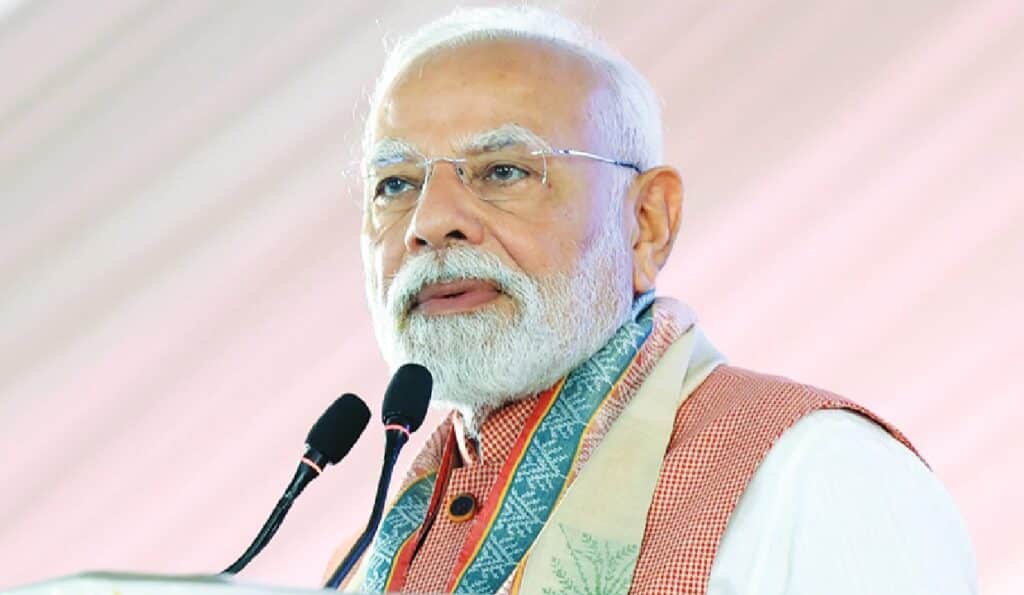
India’s political spotlight turned to Kolkata as Prime Minister Narendra Modi addressed a massive rally at the historic Brigade Parade Ground, launching development projects worth ₹18,680 crore while sharpening the Bharatiya Janata Party’s campaign narrative ahead of the 2026 West Bengal Assembly elections.
The rally marked the culmination of the BJP’s statewide Parivartan Yatra campaign and served as a major show of political strength in a state long dominated by Mamata Banerjee and her party, the All India Trinamool Congress.
Addressing thousands of supporters who travelled from across the state, the prime minister framed the event as both a development milestone and a political moment for West Bengal.
“A new chapter of development is being written from the soil of Bengal today,” Modi said as he announced the infrastructure package, describing it as part of a broader effort to strengthen connectivity and economic growth in the region.
At the same time, the rally underscored the intensifying political contest in the state as parties begin positioning themselves for the next assembly election.
Mega Rally
The gathering at Brigade Parade Ground marked the culmination of the BJP’s Parivartan Yatra, a political outreach campaign that travelled across several districts of West Bengal in recent months.
Supporters arrived in large numbers from different regions, with party organisers arranging buses, trains and organised convoys to bring workers and supporters to the state capital. The gathering was estimated to draw close to one lakh participants, reflecting the scale of mobilisation by the BJP ahead of the upcoming election battle.
Pointing to the size of the crowd, Modi said the turnout reflected growing public support for political change in the state.
“The massive crowd gathered here today shows that the people of Bengal want change,” he told supporters.
Authorities deployed more than 3,000 police personnel in and around the venue to manage the crowd and maintain security. Traffic restrictions were imposed across central Kolkata as the city prepared for one of the largest political rallies in the state this year.
The Brigade Parade Ground has long been associated with landmark political rallies in West Bengal, making it a symbolic venue for parties seeking to demonstrate organisational strength.
Development Push
A central feature of Modi’s visit was the launch and foundation laying of infrastructure projects worth ₹18,680 crore, largely focused on improving connectivity across the state.
“These connectivity projects worth ₹18,680 crore will strengthen infrastructure and bring new opportunities for the people of West Bengal,” Modi said during the rally.
The development package includes investments in highways, railways, ports and logistics infrastructure aimed at strengthening economic corridors in eastern India.
Government officials said the projects are expected to improve trade connectivity, reduce travel time and boost industrial development across the region.
“Better roads, better rail connectivity and stronger ports will accelerate development and investment across Bengal,” Modi said while outlining the projects.
What the ₹18,680 Crore Projects Include
The infrastructure package announced in Kolkata focuses primarily on transport and logistics networks designed to strengthen economic connectivity across West Bengal.
These projects span highways, railways and port infrastructure and form part of a broader effort to improve mobility and trade routes in eastern India.
Highway Development
A major share of the investment will be directed towards national highway expansion and upgrades.
More than 420 kilometres of highways across the state will be developed or modernised at an estimated cost of about ₹16,990 crore.
Key highway stretches include segments of National Highway 19 and National Highway 114, which connect several industrial districts and major trade corridors.
Improved road connectivity is expected to reduce travel time between cities and support faster movement of freight across the region.
Kharagpur Moregram Corridor
One of the most significant projects announced is the Kharagpur Moregram economic corridor.
The corridor, stretching roughly 231 kilometres, is designed to strengthen logistics connectivity across western and northern parts of the state.
Once completed, the corridor is expected to improve the movement of goods between industrial zones, ports and neighbouring states, boosting trade and regional economic activity.
Railway Connectivity
Railway infrastructure also featured in the development announcements.
The prime minister flagged off the Purulia Anand Vihar Terminal Express, a new train service connecting Purulia in West Bengal with Delhi’s Anand Vihar Terminal.
Several railway stations in the state are also set to be redeveloped under the national Amrit Bharat Station Scheme, which aims to modernise passenger facilities and improve infrastructure across the country’s rail network.
Port Infrastructure
The development package also includes upgrades to port infrastructure in the Kolkata region.
Projects include the mechanisation of a berth at the Haldia Dock complex and riverbank protection works along the Hooghly river.
These initiatives are expected to improve cargo handling efficiency and strengthen maritime trade operations in eastern India.
Political Attack
Alongside the development announcements, Modi delivered a sharp critique of the state government led by Mamata Banerjee.
He accused the ruling party of corruption and governance failures, alleging that political syndicates and irregularities had hindered economic growth in the state.
“The people of Bengal are tired of corruption, cut money and political violence,” Modi said during the address.
He also argued that development should reach ordinary citizens without intermediaries or misuse of public funds.
“Development should reach every household without middlemen and without corruption,” he said.
Leaders of the Trinamool Congress have repeatedly rejected such accusations and accused the BJP of politicising development projects for electoral advantage.
Clash Near Venue
Even as the rally drew thousands of supporters, tensions between rival political groups surfaced in parts of the city.
Clashes were reported in the Girish Park area of Kolkata, located about five kilometres from the rally venue. Supporters of the BJP and the Trinamool Congress allegedly confronted each other during the incident.
Witnesses reported stone throwing and heated exchanges between the groups.
A police officer and several political workers were injured, including BJP leader Tamaghna Ghosh. Police later intervened and deployed additional forces to restore order and prevent further escalation.
Such confrontations have periodically accompanied major political events in West Bengal’s highly polarised political landscape.
Security Operation
Given the scale of the rally and the tense political environment, authorities implemented extensive security measures across the city.
Thousands of police personnel were stationed at key points around the Brigade Parade Ground and surrounding neighbourhoods.
Barricades, security checks and crowd management systems were put in place to ensure the rally proceeded without major disruptions.
Police officials said the arrangements were designed to maintain law and order while accommodating the large gathering of supporters.
Election Stakes
The rally comes at a crucial moment in the run up to the 2026 West Bengal Assembly elections.
Over the past decade the BJP has significantly expanded its political presence in the state and has emerged as the principal challenger to the Trinamool Congress.
Although the party fell short of forming a government in the 2021 assembly election, it substantially increased its vote share and seat tally.
During his speech, Modi also framed the upcoming election as an opportunity for the state to redefine its development trajectory.
“Bengal has always led India in culture, intellect and industry. It deserves development that matches its potential,” he said.
For Mamata Banerjee and the Trinamool Congress, the next election represents a test of the party’s long standing dominance in the state.
For the BJP, victory in West Bengal would represent a major political breakthrough in eastern India.
Road to 2026
As the rally concluded, Modi delivered a final message that many observers interpreted as a direct reference to the coming electoral battle.
“No one can stop the people of Bengal when they decide to bring change,” he said.
The BJP is expected to intensify its campaign through further rallies, grassroots outreach and targeted messaging across the state.
The Trinamool Congress is likely to counter by highlighting welfare schemes, development programmes and its record in state governance.
With development promises, political accusations and sporadic clashes already shaping the narrative, the road to the 2026 election is expected to be fiercely contested.
The massive gathering in Kolkata therefore served not only as a platform for infrastructure announcements but also as an early signal that the battle for West Bengal’s political future has begun.


