

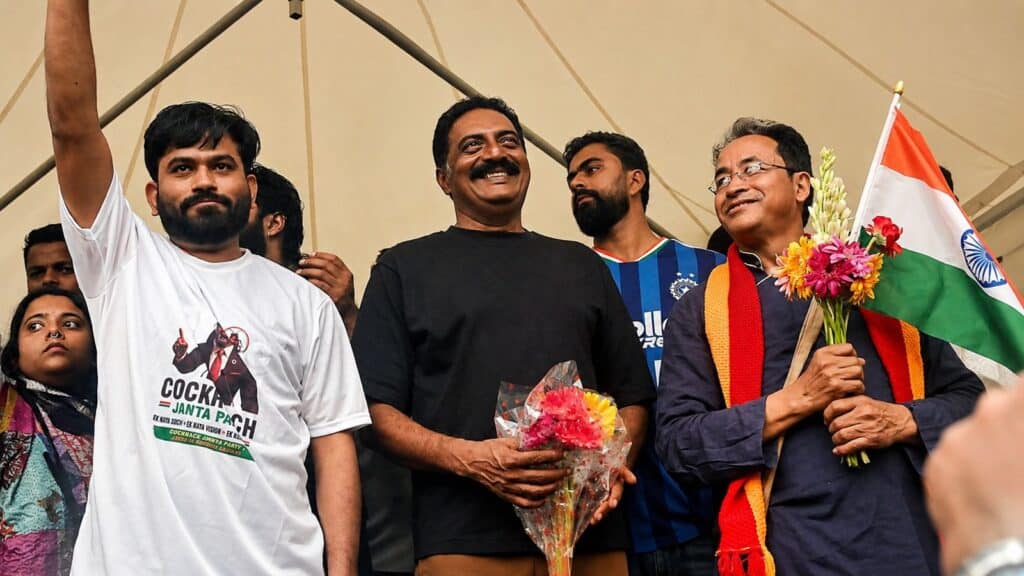
Actor and activist Prakash Raj joined the Cockroach Janta Party (CJP) protest in Bengaluru on Sunday, adding political weight to a student-led movement that has rapidly expanded across India over alleged examination irregularities and growing concerns over institutional accountability.
Raj appeared at Freedom Park alongside climate activist Sonam Wangchuk and CJP founder Abhijit Dipke, addressing hundreds of students and young professionals who gathered despite heavy rain. The protest, which initially began as an online satirical campaign, has now evolved into a wider national movement centred on the NEET-UG paper leak controversy, alleged flaws in CBSE’s digital on-screen marking system and wider frustration over how competitive examinations are being handled.
The Bengaluru demonstration marks one of the movement’s most high-profile moments so far, with Raj’s participation giving the campaign greater political visibility.
CJP Gains Ground
The Cockroach Janta Party began as an internet-driven protest movement, using satire and symbolism to challenge what organisers describe as systemic failures in education and governance.
Its unusual name was adopted deliberately as a symbol of survival and resistance. In recent weeks, however, the movement has shifted from social media into physical demonstrations, with protests taking place in Delhi, Pune, Lucknow and Amritsar.
At the centre of the campaign is the demand for the resignation of Union Education Minister Dharmendra Pradhan over the NEET paper leak controversy, which sparked widespread criticism over the integrity of India’s examination system.
But organisers have widened their focus. Alongside NEET, protesters are now raising concerns over alleged irregularities in CBSE’s digital evaluation process, arguing that students are increasingly losing trust in the transparency and fairness of results.
CJP founder Abhijit Dipke has repeatedly said the movement is not aligned with electoral politics but is instead focused on accountability and reform. A day before the Bengaluru protest, CJP formally announced Raj’s participation, a move that significantly increased attention around the event.
Bengaluru Protest Deepens
Freedom Park, a long-standing site for political protest in Karnataka, became the latest focal point of the movement on Sunday.
Despite torrential rain, hundreds of students remained at the venue, carrying placards and raising slogans against the government and the education system. One of the most visible banners read “Say no to British Janata Party,” a slogan aimed directly at the BJP and one that quickly became a defining image of the protest.
The central demand remained the same: Dharmendra Pradhan’s resignation.
Students at the protest spoke of growing anxiety over repeated exam controversies, saying paper leaks, evaluation issues and administrative failures had undermined faith in merit-based opportunities.
For many protesters, the issue has grown beyond a single examination controversy.
It now reflects a larger crisis of trust between students and institutions.
The movement also showed signs of widening geographically. Parallel protests were reported in Hyderabad on Sunday, where demonstrators raised similar concerns over NEET and CBSE evaluation systems, underlining the campaign’s expanding national reach.
Raj’s Sharp Intervention
Prakash Raj’s speech was the defining political moment of the Bengaluru protest.
Raj had earlier been expected to attend the first CJP demonstration at Delhi’s Jantar Mantar but was unable to do so because of prior commitments. His Bengaluru appearance, therefore, carried symbolic importance for organisers.
Addressing the crowd, Raj sharply criticised elected representatives, accusing them of failing to address the concerns of students.
“The elected leaders should do their jobs.”
The statement drew loud applause and set the tone for the gathering.
He then framed the protest as a sign of generational resistance.
“Youth of this country has decided to fight.”
The remark quickly became the central message of the protest and gained wide traction online.
Raj went further, directly criticising older political leadership.
“Uncles and aunties, you are ruling this country after retirement age. Go away.”
The line reflected the broader frustration among younger Indians who increasingly feel excluded from decisions affecting their future.
In one of his strongest remarks, Raj also pushed back against attempts to discredit dissent.
“Call us Pakistanis, call us terrorists, we are not scared.”
That statement added a sharper political edge to the movement and framed it within the wider debate over freedom of expression.
Wangchuk and Dipke
Sonam Wangchuk and Abhijit Dipke used the protest to broaden its message beyond examination reform.
Wangchuk argued that the issue represented a wider failure of trust in institutions and called for a more transparent and accountable system.
“We want a fear-free India, a hatred-free India, where everyone enjoys freedom without question.”
His speech positioned the movement as part of a larger democratic conversation rather than simply an education protest.
Dipke, meanwhile, said the movement would intensify if its demands were ignored. He announced a major mobilisation at Delhi’s Jantar Mantar on June 20, warning that students from across India would gather in the capital if Dharmendra Pradhan did not step down.
The June 20 protest is expected to be the biggest test of CJP’s ability to sustain momentum.
For the government, the challenge is no longer limited to the fallout of the NEET paper leak. It now represents a broader political test over how institutions respond to growing anger among India’s youth.
With figures like Prakash Raj and Sonam Wangchuk now openly backing the campaign, the movement has moved beyond online satire and entered the national mainstream.
Whether it remains a student-led protest or develops into a wider political force may become clearer in the days ahead.


