

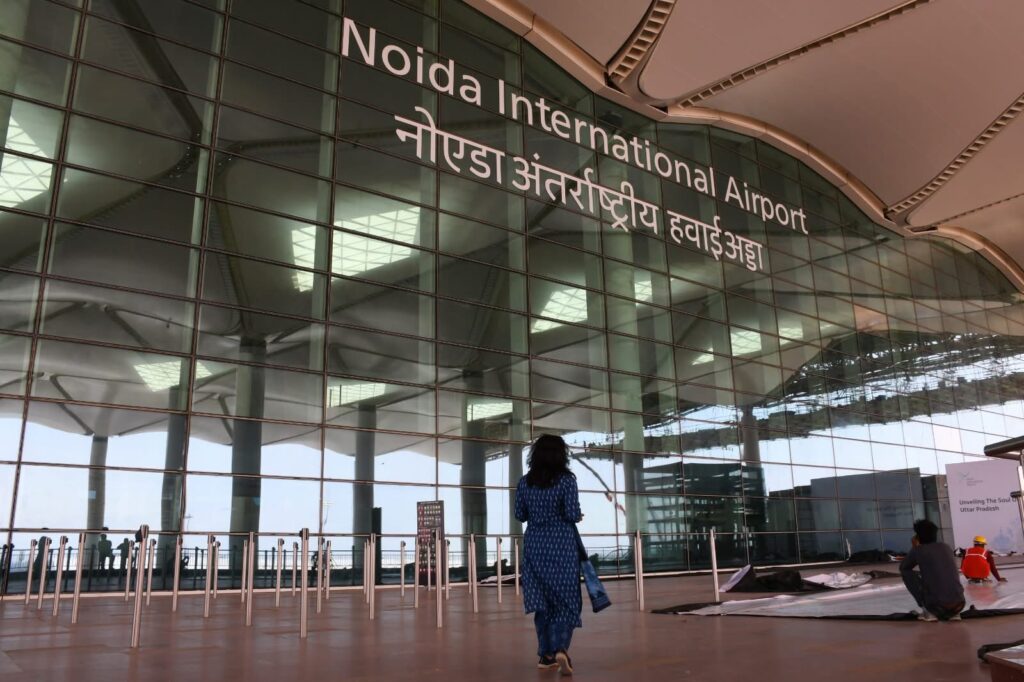
On March 28, 2026, Prime Minister Narendra Modi will inaugurate Phase-1 of the Noida International Airport, a project that marks a decisive shift in India’s aviation and infrastructure strategy. Developed at an investment of ₹11,200 crore, the airport is positioned not just as an alternative to Delhi’s existing capacity, but as a long-term solution to rising air traffic, logistics demand, and regional economic expansion.
Located in Jewar, Gautam Buddha Nagar district of Uttar Pradesh, the airport is expected to serve as a critical node in North India’s connectivity network, while also showcasing India’s push toward sustainable, globally competitive infrastructure.
A Dual-Airport Strategy for NCR
For decades, Indira Gandhi International Airport has remained the primary aviation gateway for Delhi-NCR, handling one of the highest passenger volumes in Asia. However, with air traffic in India growing rapidly year-on-year, capacity constraints have become increasingly visible.
The launch of the Noida International Airport introduces a dual-airport system, a model widely adopted by global megacities such as London and New York. This approach distributes passenger load, reduces congestion, and enhances operational efficiency across the region.
Jewar’s location along the Yamuna Expressway gives it a strategic advantage. It is expected to cater not only to Delhi and Noida but also to a wider catchment area that includes western Uttar Pradesh, parts of Haryana, and even neighboring Rajasthan. Officials have indicated that this geographic positioning will significantly reduce travel time for millions of passengers who currently rely solely on Delhi’s airport.
In the long term, both airports are expected to function as an integrated aviation network, allowing airlines to optimize routes while offering passengers greater flexibility and improved travel experiences.
Scale, Design and Operational Readiness
Phase-1 of the Noida International Airport has been designed with scalability at its core, reflecting not just current demand but projected growth over the next several decades.
The initial phase will handle 12 million passengers annually, with infrastructure that can be expanded in stages to reach 70 million passengers per year. The airport features a 3,900-metre runway, capable of accommodating wide-body aircraft and long-haul international operations.
In its early phase, the airport is expected to manage dozens of daily flights, with a gradual increase as airline operations scale up. Importantly, the facility has already secured an aerodrome license from the Directorate General of Civil Aviation, confirming its compliance with safety and operational standards required for commercial aviation.
This certification enables round-the-clock, all-weather operations, placing Jewar among fully equipped modern aviation hubs from the outset.
The terminal design emphasizes passenger efficiency, digital processing systems, and future expansion without major structural disruption.
Sustainability at the Core
A defining feature of the project is its ambition to become India’s first net-zero emissions airport.
Unlike traditional airports where sustainability is often an afterthought, Jewar has been conceptualized with environmental considerations embedded into its design and operations. Plans include large-scale solar energy generation, energy-efficient terminal infrastructure, electric ground handling systems, and comprehensive water and waste management solutions such as rainwater harvesting and recycling.
This approach aligns with India’s broader climate commitments and signals a shift toward greener infrastructure development.
Aviation remains one of the most carbon-intensive sectors globally, and projects like Jewar signal a move toward mitigating environmental impact through innovation and planning.
Reflecting the broader vision behind such projects, Prime Minister Narendra Modi has previously stated:
“World-class infrastructure is the foundation of a new India and a driver of economic growth.”
The emphasis on sustainability at Jewar closely aligns with this long-term policy direction.
Economic and Logistics Transformation
Beyond passenger movement, the airport is being positioned as a major logistics and economic hub.
The project includes plans for dedicated cargo terminals, integrated logistics parks, and a Maintenance, Repair, and Overhaul facility. These components are expected to significantly enhance cargo handling capacity in North India while reducing pressure on existing hubs.
The airport is expected to strengthen supply chains across sectors such as e-commerce, manufacturing, and exports.
The airport’s presence is already influencing economic activity in the surrounding region. Real estate development in Noida and Greater Noida has seen increased interest, while industrial zones along the Yamuna Expressway are being positioned for rapid expansion.
Analysts suggest that the project could generate thousands of direct and indirect jobs, attract both domestic and international investment, and accelerate the development of a broader economic corridor linking Delhi, Noida, Agra, and beyond.
In effect, the project is transforming Jewar into a strategic economic centre within North India.
Connectivity, Challenges and the Road Ahead
While the scale and ambition of the airport are evident, connectivity remains a critical factor in determining its long-term success.
At present, the airport is accessible primarily via the Yamuna Expressway, offering strong road connectivity. However, metro extensions, rapid rail links, and multi-modal transport systems are still under development.
Authorities have outlined plans to integrate the airport with regional transport networks, including proposed high-speed rail and metro connectivity. These developments are expected to improve accessibility over time.
Experts note that last-mile connectivity will play a decisive role in determining passenger adoption in the initial years.
Despite these challenges, the broader trajectory remains positive. The project has already overcome decades of delays. First proposed in the early 2000s, it faced land acquisition and policy hurdles before gaining momentum after 2017. Construction began in 2021, and within five years, Phase-1 is ready for inauguration.
As operations begin, the focus will shift toward scaling airline partnerships, improving connectivity, and ensuring seamless integration into India’s aviation network.
A Defining Infrastructure Moment
The inauguration of the Noida International Airport represents more than the launch of a new airport. It marks a turning point in India’s infrastructure evolution.
By combining scale, sustainability, and strategic planning, the project reflects a broader shift toward long-term, future-ready development.
As Prime Minister Narendra Modi inaugurates Phase-1 on March 28, the message is clear: India is not just expanding its aviation capacity, it is redefining how infrastructure can drive national progress.
In the years ahead, Jewar could emerge as a benchmark for building infrastructure that is not only larger, but smarter and more sustainable.


