

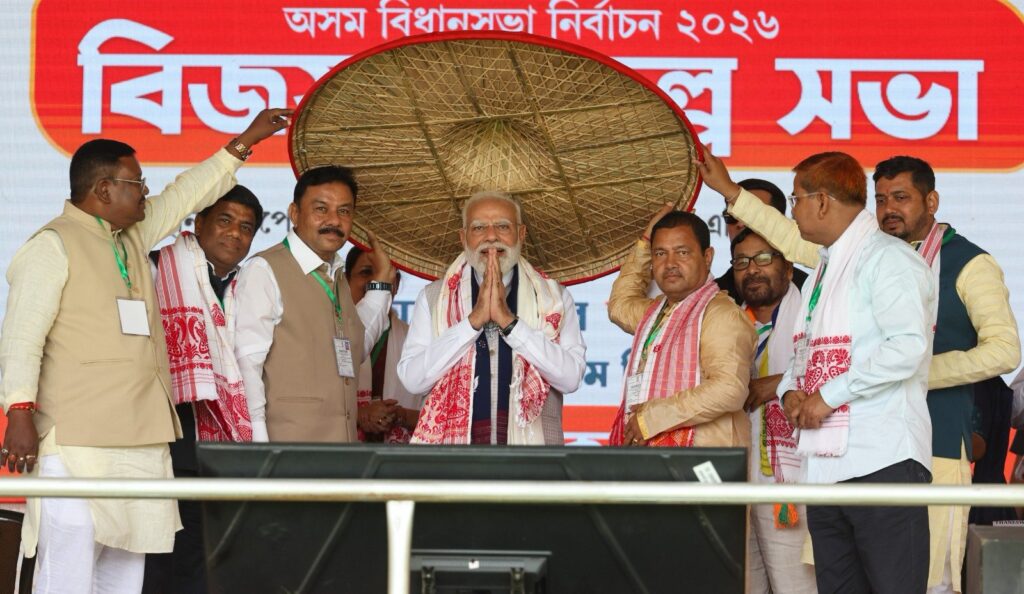
Prime Minister Narendra Modi has intensified the Bharatiya Janata Party’s campaign in Assam with a high-impact series of rallies, placing Barpeta at the centre of a final electoral push that signals growing momentum for the National Democratic Alliance.
Addressing rallies across Barpeta, Hojai and Dibrugarh in a single day, Modi’s outreach reflects a carefully coordinated strategy to consolidate support across regions ahead of the April 9 single-phase election for 126 seats. The scale, timing and messaging of these rallies underline a campaign entering its most decisive phase.
Final Push Gains Momentum
The closing phase of campaigning has seen a visible escalation in intensity, with the BJP deploying its top leadership to reinforce its position across Assam.
The NDA enters the election with a strong base, having secured 86 seats in 2021, including 60 won by the BJP. This time, party leaders are projecting not just continuity but expansion.
Opinion polls have added to this momentum narrative. The IANS-Matrize survey projects the NDA winning between 96 and 98 seats, suggesting a potential strengthening of its mandate.
Modi, projecting confidence, told supporters: “Assam has chosen development, and this trust will bring the NDA back with greater strength.”
He also framed the election as a decisive moment for continuity in governance: “This election is about keeping the pace of progress moving forward without interruption.” Voting is scheduled for April 9, with results to be declared on May 4.
Development Pitch Backed by Data
A central theme of the BJP’s campaign has been the projection of economic growth and infrastructure development under its governance.
Modi highlighted that Assam’s economy has expanded significantly over the past decade, with the gross state domestic product rising from approximately 2.27 lakh crore rupees to around 8.71 lakh crore rupees.
He linked this growth to policy stability and central support, stating: “In the last decade, Assam has moved from limited growth to becoming a key driver of development in the Northeast.”
The government has also pointed to a reduction in poverty levels, stating that millions of people have moved out of poverty during this period.
Infrastructure development has been positioned as a key achievement. The BJP has emphasised improved connectivity through new bridges over the Brahmaputra, expansion of healthcare facilities, and the growth of industrial projects.
Chief Minister Himanta Biswa Sarma has reinforced this narrative, highlighting roads, welfare delivery and governance improvements.
The state government has also pointed to land reforms, including the distribution of land rights and efforts to clear encroached land.
Sharp Attacks Define Campaign Tone
Alongside development claims, the campaign has been marked by strong political messaging directed at the opposition.
Modi accused the Congress of relying on vote bank politics and argued that such policies had previously slowed Assam’s progress.
He sharpened his stance on migration issues, telling the rally: “Infiltration is a life and death issue for Assam, and we are committed to protecting its identity.”
He also criticised past governance approaches, stating: “Those who ruled earlier focused on politics of division, not development.”
These remarks reflect the continued importance of identity, security and political trust in shaping electoral outcomes in Assam.
Opposition Push Faces Momentum Challenge
The opposition, led by Congress president Mallikarjun Kharge, has attempted to counter the BJP’s narrative with a focus on economic concerns and governance gaps.
Congress leaders have promised broader prosperity, welfare expansion and more inclusive growth, while also criticising the state government over alleged corruption and uneven development.
However, the opposition faces a challenging electoral environment. The BJP’s strong organisational network, combined with its aggressive campaign strategy and favourable opinion polls, has made it difficult for rivals to shift the narrative in the final phase.
Regional parties continue to influence the contest in several constituencies, adding complexity to the electoral landscape.
Voters Weigh Growth Against Ground Issues
Despite the dominance of large rallies and high-level messaging, voter decisions are expected to be shaped by a mix of development claims and local concerns.
Flood management remains a recurring issue in Assam, affecting livelihoods and infrastructure across large parts of the state. Employment opportunities and income stability are also key concerns, particularly among younger voters.
Modi also sought to connect directly with voters on these issues, stating: “Our focus is on creating opportunities, improving livelihoods and ensuring that development reaches every household.”
The campaign has included targeted outreach to key communities, including tea garden workers, reflecting the importance of economic security and welfare in shaping voter sentiment.
As the election approaches, Barpeta has emerged as a symbolic focal point of the broader contest.
With voting set for April 9 and results due on May 4, the electorate will ultimately decide whether the NDA’s current momentum translates into a stronger mandate.


