

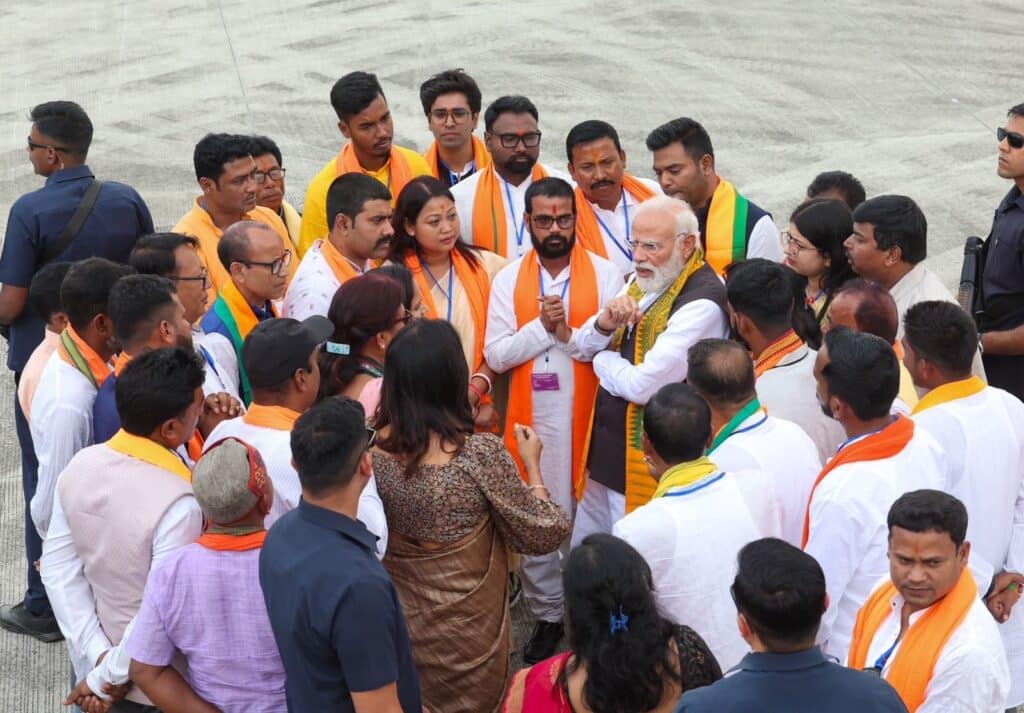
Prime Minister Narendra Modi on Monday addressed Bharatiya Janata Party workers across Tamil Nadu through a virtual interaction under the ‘Mera Booth Sabse Mazboot Samvaad’ programme, marking a key moment in the party’s final campaign phase before the April 23 Assembly elections.
The interaction, held around 4 p.m. IST, brought together booth-level workers from multiple constituencies, reflecting the BJP’s emphasis on direct communication between central leadership and grassroots cadres. Party officials said the session was designed to align local campaign efforts with broader national messaging, while also boosting morale in a state where the party is still working to expand its organisational base.
Modi used the platform to directly acknowledge the efforts of party workers operating in what he described as a politically challenging environment. He credited them with strengthening the party’s presence in Tamil Nadu and playing a visible role in shaping political discourse during the campaign.
Attack on DMK Governance
During his address, Modi sharpened his criticism of the ruling Dravida Munnetra Kazhagam, stating that BJP workers had “exposed the poor governance” of the state government through sustained engagement with voters.
The remarks form part of a broader campaign narrative in which the BJP and its allies have targeted the DMK on issues related to governance, administration and alleged corruption. By attributing this political messaging to grassroots workers, Modi placed cadre activity at the centre of the party’s electoral strategy.
Union Minister Piyush Goyal, who has been campaigning in the state, echoed this line, saying BJP workers were “inspired” and determined to challenge what he described as a “corrupt” government. These statements underline the opposition alliance’s attempt to frame the election as a referendum on the DMK’s performance in office.
At the same time, the BJP’s messaging has sought to highlight governance as a central issue, positioning its campaign as an alternative to the incumbent administration.
Alliance and Ground Strategy
The BJP is contesting the election as part of the National Democratic Alliance, in partnership with the All India Anna Dravida Munnetra Kazhagam, which remains the principal opposition force in the state. The party is contesting 27 seats under the alliance arrangement, while the AIADMK is leading the coalition’s broader electoral effort.
The election, covering all 234 Assembly constituencies in a single phase, has heightened the importance of coordinated campaigning and efficient resource deployment. Within this framework, the BJP has placed significant emphasis on booth-level management, which it views as critical to converting voter sentiment into actual turnout.
The ‘Mera Booth Sabse Mazboot’ initiative is central to this approach. Party leaders have repeatedly stressed that strong booth committees can influence electoral outcomes, particularly in closely contested constituencies. Modi’s interaction reinforced this message, urging workers to prioritise voter outreach, maintain regular contact with local communities and ensure effective polling-day mobilisation.
This focus reflects a broader organisational model that combines central leadership visibility with decentralised execution at the grassroots level.
DMK Hits Back
The ruling DMK has responded with a strong counter-campaign, rejecting the opposition’s allegations and defending its record in government. Udhayanidhi Stalin warned that the BJP-AIADMK alliance could make the state “retrogressive”, framing the election as a choice between competing visions for Tamil Nadu’s future.
Chief Minister M. K. Stalin has also criticised the opposition alliance, accusing it of relying on rhetoric rather than presenting concrete policy alternatives. DMK leaders have emphasised their administration’s welfare programmes, development initiatives and governance model, positioning these as key achievements ahead of the polls.
The party has also highlighted concerns about centralisation, seeking to contrast its regional approach with what it portrays as increased influence from national parties. This narrative draws on Tamil Nadu’s long-standing political tradition, where regional identity and state autonomy have played a significant role in shaping voter preferences.
Final Phase Push
With polling scheduled for April 23, campaign activity across Tamil Nadu has intensified, with both alliances seeking to consolidate support in the final stretch. Modi’s virtual outreach is being seen as part of a broader effort to energise party workers and ensure last-mile mobilisation.
The BJP’s approach reflects an attempt to expand its footprint in a state historically dominated by Dravidian parties, while the AIADMK is aiming to regain political ground as the principal opposition force. For the DMK, the election represents a test of its governance record and its ability to retain voter confidence.
The contest remains closely watched, with organisational strength, alliance coordination and voter turnout expected to play decisive roles. As campaigning enters its final phase, both sides are intensifying efforts to shape the narrative and secure electoral advantage in what is shaping up to be a significant political test for all major players involved.


