

West Bengal has delivered a political earthquake. In one of the most consequential state election results in recent Indian history, the Bharatiya Janata Party (BJP) has secured a sweeping mandate in the 2026 Assembly elections, ending the Trinamool Congress (TMC)’s long hold over the state and dealing a major blow to Chief Minister Mamata Banerjee.
As counting progressed across 294 seats, the BJP crossed the halfway mark with ease and moved toward a commanding tally, while the TMC suffered sharp losses in districts once considered reliable strongholds. The result signals not only a change of government in one of India’s most politically influential states, but also a broader shift in the country’s opposition landscape.
Counting was held for 293 of 294 seats on result day after re-polling was ordered in Falta constituency. The election also recorded turnout of more than 92%, one of the highest in the state’s history.
For more than a decade, West Bengal had been synonymous with Mamata Banerjee’s combative style of regional politics. Her rise in 2011 ended 34 years of Left Front rule and reshaped Bengal’s political identity. In 2026, voters appear to have chosen another moment of transformation.
BJP’s Historic Bengal Win
The BJP’s victory is especially significant because West Bengal was long considered difficult terrain for the party. With a strong regional identity, deep anti-Congress and anti-central traditions, and a history shaped by Left politics, Bengal had resisted the BJP’s expansion longer than many other major states.
That began to change over the past decade. The party steadily increased its vote share, performed strongly in the 2019 general election, emerged as the principal challenger in the 2021 Assembly polls, and has now completed its rise by capturing power.
Prime Minister Narendra Modi celebrated the verdict with a message on X, writing, “The Lotus blooms in West Bengal! The 2026 West Bengal Assembly Elections will be remembered forever. People’s power has prevailed and BJP’s politics of good governance has triumphed. I bow to each and every person of West Bengal.”
He added, “The people have given a spectacular mandate to BJP and I assure them that our Party will do everything possible to fulfil the dreams and aspirations of the people of West Bengal. We will provide a Government that ensures opportunity and dignity to all sections of society.”
BJP leaders said voters had chosen change after years of allegations over corruption, political violence, local factionalism and unemployment concerns.
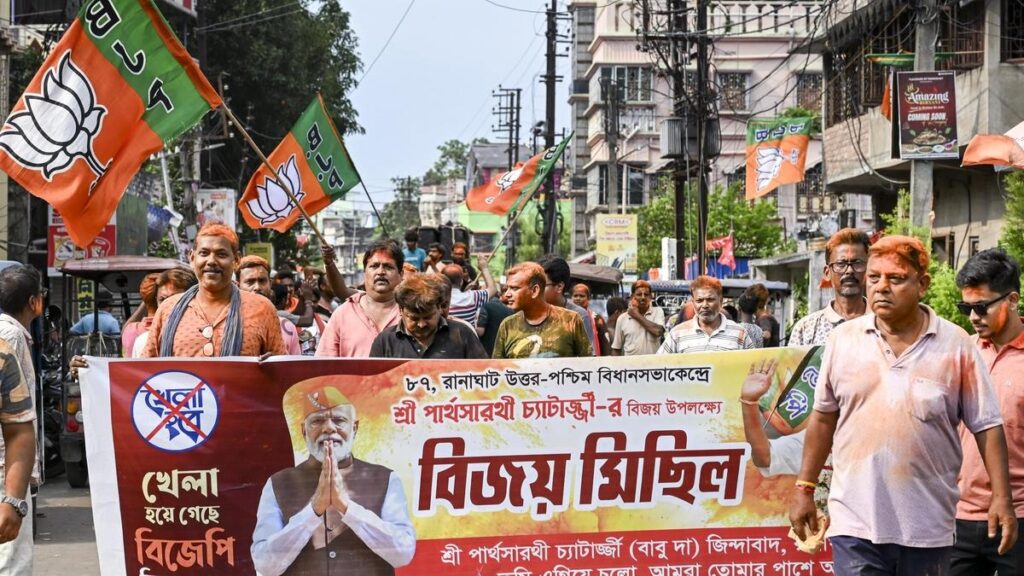
Celebrations broke out in Kolkata, Siliguri, Asansol and other cities, where supporters gathered with party flags, drums and victory processions. For the BJP, the win represents one of its most important eastern India breakthroughs and a symbolic expansion into territory once viewed as politically resistant.
Mamata’s Biggest Setback
For Mamata Banerjee, the verdict marks the most serious setback of her political career since she first came to power fifteen years ago. She had built her reputation as one of India’s most formidable regional leaders and one of the strongest national critics of the BJP.
Her Trinamool Congress had previously dominated Bengal politics through a combination of welfare programmes, grassroots organisation and Banerjee’s personal popularity. But in this election, that formula appears to have weakened across enough constituencies to trigger a statewide reversal.
Banerjee’s own Bhabanipur seat became one of the most closely watched contests of the day. Counting there was briefly halted during the process, heightening tension around the constituency. Party workers from both sides gathered outside centres as security forces maintained order.
Earlier, Banerjee had reportedly urged party agents to remain alert through the final rounds of counting and expressed confidence in a TMC victory. But as trends turned decisively against the party, senior leaders acknowledged that the result would require reflection and reorganisation.
The defeat also carries national consequences. Banerjee had often been projected as a possible anchor figure for opposition unity against the BJP. A weakened TMC could alter those calculations significantly.
Why BJP Won
Several factors appear to have driven the BJP’s breakthrough. Political analysts point to anti-incumbency after years in office, concerns around governance, and the BJP’s expanding booth-level machinery across urban, semi-urban and border regions.
The party campaigned aggressively on law and order, transparency in welfare delivery, jobs, infrastructure and closer coordination with the central government. It also targeted younger voters and first-time voters through digital outreach and district-level mobilisation.
The TMC, meanwhile, relied heavily on its record of welfare schemes and Banerjee’s image as a defender of Bengali identity. While that message retained support in some pockets, it was not enough to prevent erosion in several battleground seats.
The BJP also benefited from a longer-term organisational strategy. What was once a marginal force in Bengal politics gradually built local leadership networks, recruited defectors from rival parties, and transformed itself into a competitive statewide machine.
For many voters, the election became less about ideology and more about whether Bengal needed continuity or change. This time, change appears to have won.
Counting Day Drama
The result day itself reflected the intensity of the contest. Counting centres across the state were placed under tight security, with officials repeatedly appealing for calm.
Several constituencies drew intense attention. In parts of north Bengal and industrial belts, BJP candidates opened strong leads early and maintained them. In some traditional TMC areas, the party managed to hold ground, though often with reduced margins.
Bhabanipur remained the emotional centre of the day because of its association with Mamata Banerjee. Elsewhere, districts such as Asansol, Bhatpara, Naihati and several suburban seats illustrated the BJP’s expanding reach.
Outside counting centres, scenes varied sharply. BJP workers celebrated with sweets and slogans, while TMC supporters waited anxiously for later rounds. In markets and tea stalls, many residents described the verdict as a turning point after years of polarised politics.
The high public interest underlined Bengal’s reputation as one of India’s most politically engaged states, where elections are followed with unusual intensity.
What Next for Bengal
The immediate challenge for the BJP will be turning electoral success into governance. Voters are likely to judge the new administration on jobs, industry, law and order, public services and whether welfare schemes continue smoothly under new leadership.
The party will also face the task of governing a state with a distinct political culture and strong regional identity. Winning Bengal is one challenge. Building durable trust may be another.
For the TMC, the result raises difficult questions about leadership transition, organisational fatigue, candidate selection and how to rebuild after a defeat of this scale. Mamata Banerjee remains a major political figure, but her next move will be watched closely.
Nationally, the verdict strengthens the BJP’s narrative of continued expansion while weakening opposition hopes of using Bengal as a strategic counterweight.
The 2026 West Bengal election may ultimately be remembered as more than a routine transfer of power. It could be the moment an old political era ended, a new one began, and one of India’s most important states redrew its future.


