

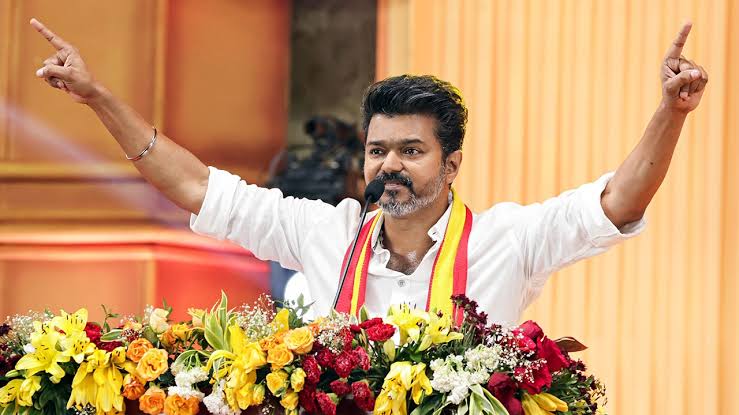
Tamil Nadu Election Results 2026 have delivered one of the most consequential verdicts in the state’s modern political history, with actor-turned-politician Vijay leading Tamilaga Vettri Kazhagam (TVK) to a landmark breakthrough that has disrupted decades of dominance by the DMK and AIADMK. Counting trends through the day showed TVK emerging as the single-largest party, registering a debut performance few new entrants have achieved in Tamil Nadu’s highly structured political landscape.
The result is significant not only because a new party has risen so quickly, but because it reflects a clear shift in voter behaviour. Large sections of the electorate, including younger voters, urban constituencies and first-time participants, appeared willing to move beyond traditional party loyalties. What had long been seen as a two-pole contest in Tamil Nadu has now been fundamentally altered by the arrival of a third force with statewide reach.
As the final phases of counting continued, attention moved rapidly from campaign narratives to government formation arithmetic, leadership responses and the broader meaning of a verdict that could reshape Tamil Nadu politics for years.
TVK Breakthrough
The defining story of the election was the scale of TVK’s performance in its first major Assembly contest. Election data during counting showed the party winning seats while also leading in dozens more, placing it ahead of both the DMK and AIADMK.
TVK also recorded symbolic victories in prominent urban seats including Chennai’s Anna Nagar and strong performances in constituencies such as Mylapore, where rivals trailed. The breadth of results suggested that support for Vijay’s party extended beyond celebrity enthusiasm and had converted into an organised electoral network.
Reacting to the trends, Vijay thanked voters and framed the verdict as a mandate for public change. “This victory belongs to the people of Tamil Nadu.” Party leaders described the result as the beginning of a new political chapter.
Later in the day, Prime Minister Narendra Modi congratulated TVK for its “impressive performance”, adding national significance to the outcome.
DMK Faces Setback
For Chief Minister M.K. Stalin and the DMK, the verdict represented a serious reversal after entering the election with the advantages of incumbency, organisational depth and an established welfare record. Throughout the day, constituency-level trends showed the party under pressure in several regions where it had expected stronger resistance to challengers.
One of the most closely watched battles was Kolathur, where TVK’s V.S. Babu defeated Stalin in a major upset. The loss of such a high-profile seat turned into one of the defining symbols of the election and underlined the scale of the anti-establishment mood in parts of the electorate.
The DMK did retain some important positions. Deputy Chief Minister Udhayanidhi Stalin was reported set to win Chepauk-Thiruvallikeni, helping the party preserve a foothold in central Chennai.
In a brief response, Stalin accepted the democratic mandate. “We respect the people’s verdict and will continue to serve Tamil Nadu.” Political observers now expect the party to reassess campaign strategy, voter outreach and leadership messaging after a result that sharply altered the balance of power.
AIADMK Left Behind
The AIADMK entered the election hoping to reclaim space as the principal challenger to the ruling party. Instead, it found itself overtaken by TVK’s rapid rise and unable to convert dissatisfaction with the government into a statewide comeback.
Counting updates showed the party winning a limited number of seats while leading in several others, but still trailing TVK by a considerable margin. The numbers remained far below expectations for a party seeking revival.
Although the AIADMK retained support in traditional pockets, especially in parts of western and southern Tamil Nadu, the overall result raised difficult questions about future leadership direction and electoral positioning.
Senior figures said the party would rebuild and remain a strong opposition force. “We accept the verdict with humility and will return stronger.”
Why Voters Shifted
The Tamil Nadu Election Results 2026 indicate a combination of political fatigue, generational change and effective campaign organisation. Many voters appeared ready to move beyond the long-standing DMK versus AIADMK framework that had defined state politics for decades.
Vijay’s personal appeal was clearly a factor, but the result also reflected structured booth-level mobilisation, candidate selection and messaging centred on governance, accountability and opportunity. TVK leaders repeatedly presented the party as an alternative rather than an extension of older political traditions.
Earlier in the day, TVK leader Nanjil Sampath called the trends historic. “Replacing Dravidian parties is historical.” That statement captured the sense among supporters that the election was about more than seats alone.
The turnout pattern and spread of results also suggested that TVK attracted support across social and geographic lines, an important indicator for any new party hoping to sustain itself beyond a first election.
Power Shift Begins
The immediate focus now is the final tally and the process of government formation. With the majority mark at 118 in the 234-member Assembly, all attention remains on whether TVK secures a clear mandate on its own or requires post-result support. Earlier updates showed the party close to or beyond that threshold at various stages of counting.
If Vijay forms the next government, he will face immediate expectations on jobs, welfare delivery, investment confidence and administrative appointments. If no party reaches a clear majority, negotiations with smaller parties and independents could become decisive.
Beyond the arithmetic, the larger story is already clear. Tamil Nadu voters have produced a transformative verdict. A state once seen as firmly anchored in a two-party Dravidian structure has opened a new political era, with Vijay and TVK now at its centre.


