

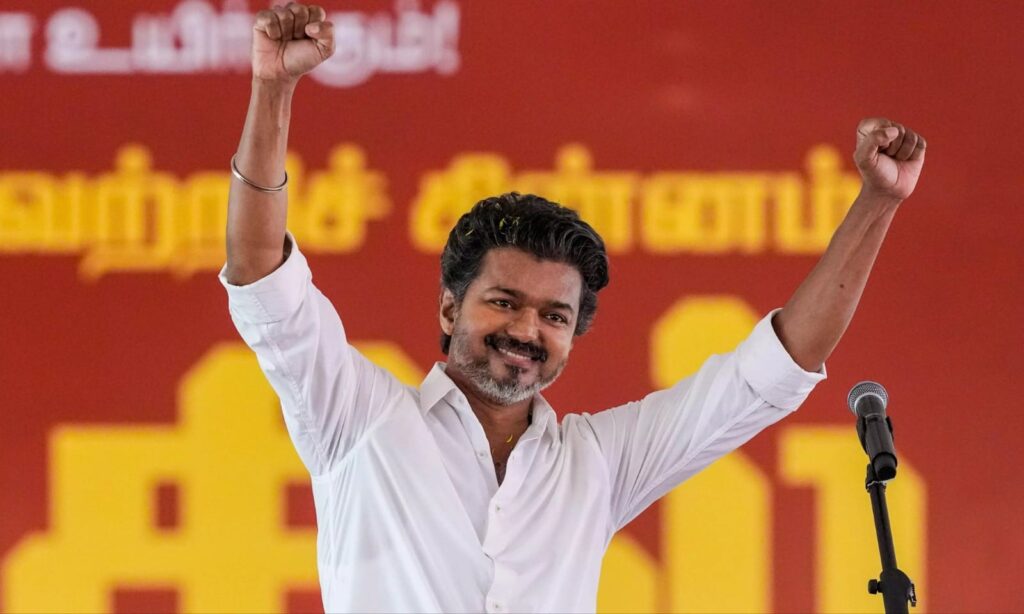
Tamil Nadu’s post-election political uncertainty deepened on Thursday as actor-politician Vijay’s Tamilaga Vettri Kazhagam (TVK) reportedly examined legal and constitutional options after Governor Rajendra Vishwanath Arlekar declined to immediately invite the party to form government despite it emerging as the single largest force in the Assembly election. What began as a routine transition of power has now developed into a high-stakes contest over mandate, majority and gubernatorial discretion.
With no party crossing the halfway mark in the 234-member Assembly, the Governor now faces a crucial constitutional decision: whether to invite the largest party first, insist on visible majority support before swearing-in, or wait for a clearer alliance claim. The result is being watched closely across India, given the scale of TVK’s breakthrough and Tamil Nadu’s political and economic importance.
Numbers Challenge
TVK won 108 seats in the 2026 Tamil Nadu Assembly election, placing it ahead of the DMK, AIADMK and all other rivals. However, a simple majority requires 118 seats, leaving Vijay’s party short of the threshold required to govern independently.
Congress, which secured five seats, has publicly backed TVK’s bid to form government. Even with that support, the bloc remains below the halfway mark, making smaller regional parties and independents crucial to the final arithmetic. Reports have also suggested that one seat may later fall vacant because Vijay contested from more than one constituency, which could briefly affect the effective tally.
Vijay has insisted that the public delivered a clear message for political change. After meeting the Governor, he said, “We have conveyed our position responsibly. We trust democratic values and constitutional process.”
For TVK, the challenge has shifted from electoral success to legislative numbers.
Governor’s Call
Governor Arlekar has become the central figure in the unfolding political battle. According to reports, the Governor told Vijay that the party had not yet demonstrated the support required to form a stable government.
Sources cited in live updates said Vijay was asked to return with evidence of support from 118 MLAs before any swearing-in process could move forward. The same reports said he was also assured that no rival party would be invited immediately while TVK continued efforts to prove its claim.
That stance has triggered debate because constitutional precedents in hung Assemblies often favour inviting the single largest party first and allowing it to prove majority through a floor test within a fixed time frame. Other precedents allow a post-poll alliance to be considered first if it can clearly demonstrate majority support.
Legal experts have long argued that in such cases, floor tests remain the most transparent and democratic method of establishing legitimacy.
Vijay’s supporters say the mandate should be tested in the House, not delayed outside it. Critics argue that inviting a party without visible numbers risks immediate instability.
Support Hunt
As the deadlock deepened, TVK intensified efforts to secure the final numbers needed for power. Reports said the party reached out to the Viduthalai Chiruthaigal Katchi (VCK), CPI and CPI(M), whose support could become decisive if negotiations succeed.
Congress also defended TVK’s right to attempt government formation, with leaders saying the people’s mandate should be respected and not weakened through procedural delay.
Political voices outside TVK joined the debate. Kamal Haasan criticised any move that ignored the largest party’s mandate, saying it would amount to “disrespecting the people’s verdict.”
Meanwhile, supporters of Vijay gathered in anticipation of a possible swearing-in ceremony, but later dispersed after no announcement was made. Reports also said Vijay declined use of any official Chief Ministerial convoy until he was formally sworn in.
If talks fail, TVK may pursue legal remedies, although no formal court petition had been confirmed.
Rival Moves
Although TVK leads the numbers race, the DMK and AIADMK remain highly relevant because neither has been politically eliminated.
The DMK, with 59 seats, has signalled patience. Former Chief Minister M.K. Stalin said the party would “watch without disturbing for six months” if TVK formed the government, while questioning whether campaign promises could be fulfilled.
That suggests a strategy of allowing TVK to face the immediate pressures of governance while preserving DMK’s organisational strength in opposition.
AIADMK, with 47 seats, also holds potential leverage. Reports said some of its MLAs were moved to Puducherry amid speculation over poaching concerns and internal disagreement over whether to support TVK.
For AIADMK, the dilemma is strategic. Supporting Vijay may keep DMK out of office, but it could also strengthen a rising rival competing for the same political space.
Both established parties therefore appear to be balancing short-term influence against long-term survival.
What Next
The most likely immediate scenarios are clear. TVK may secure fresh letters of support and renew its claim before the Governor. Raj Bhavan could then invite Vijay to form government with a deadline for a floor test. Alternatively, if no grouping demonstrates stable numbers, the deadlock could deepen and widen into a more serious constitutional impasse.
Tamil Nadu’s business community is also watching closely. The state remains one of India’s leading industrial and export hubs, home to major automobile, electronics and manufacturing investment. Political uncertainty rarely halts administration overnight, but prolonged instability can slow decision-making and unsettle investor confidence.
For Vijay, this is the defining stage of his political journey. He has already broken Tamil Nadu’s traditional two-party order and emerged as the face of a new political challenge. Whether he becomes Chief Minister now depends not on symbolism or public enthusiasm, but on legislative arithmetic.
One fact is already beyond dispute: the 2026 election changed Tamil Nadu politics. The next few days will decide who governs it.


