

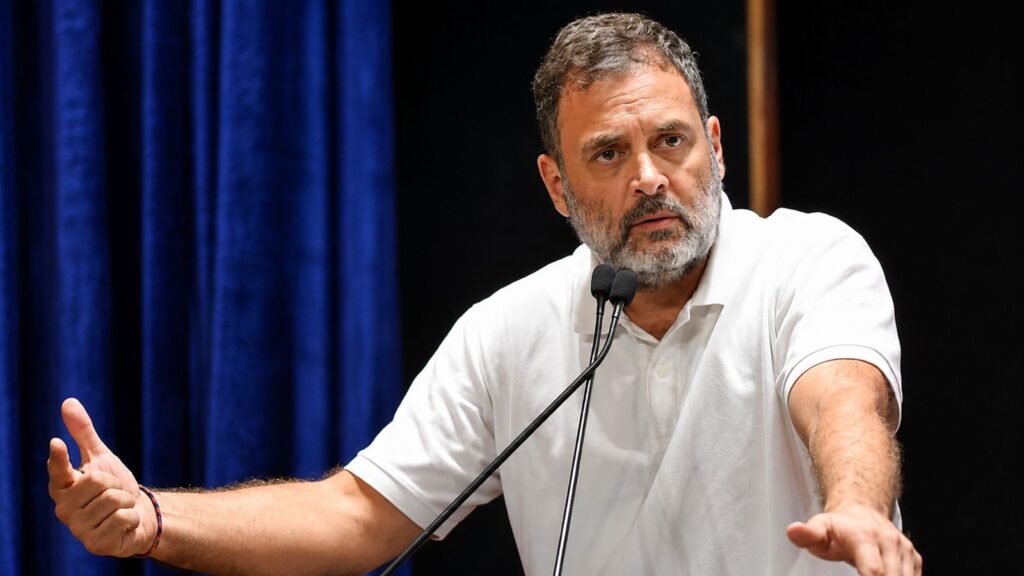
Congress leader and Leader of Opposition in Lok Sabha Rahul Gandhi on Tuesday warned that India was heading toward an “economic storm” after fresh fuel price hikes intensified political confrontation over inflation, rising crude oil prices and the Modi government’s handling of the economy.
Speaking in Raebareli, Gandhi accused Prime Minister Narendra Modi of building an economic system that favours a small group of billionaires while leaving ordinary Indians exposed to inflationary pressure and global market shocks. His remarks came amid renewed volatility in international oil markets linked to escalating tensions in West Asia and concerns over the impact of expensive crude imports on India’s economy.
Fuel Prices Trigger Political Row
The political clash followed another increase in petrol and diesel prices, marking the second hike within a week. Petrol prices in Delhi rose to ₹98.64 per litre while diesel increased to ₹91.58, adding pressure on household budgets already affected by rising food and transportation costs.
The latest revision comes at a time when global crude prices remain volatile due to tensions involving the United States and Iran, raising fears of disruptions in the Strait of Hormuz, one of the world’s most critical oil shipping routes. Analysts have warned that sustained crude prices near or above $120 per barrel could significantly increase India’s import bill and intensify inflationary pressure across sectors.
India imports nearly 85 per cent of its crude oil requirements, making the economy highly sensitive to fluctuations in global energy markets and currency movements. The weakening rupee has further increased concerns because a depreciating currency raises the cost of imported fuel.
Economists say rising fuel prices are likely to affect transportation, logistics, agriculture and manufacturing costs, with the impact eventually reflected in retail inflation and consumer spending. Several financial analysts have also warned that prolonged energy volatility could widen India’s trade deficit and place additional strain on fiscal management.
The issue has quickly evolved into a major political flashpoint, with opposition parties accusing the government of failing to shield consumers from rising prices while the BJP maintains that global instability is driving the current situation.
Rahul Gandhi Warns of Crisis
Gandhi made the remarks after inaugurating a wedding hall in Bachhrawan in Raebareli, where he linked the current economic situation to global geopolitical tensions and domestic inflation.
“A war broke out between Iran and the United States. Petrol and diesel prices have increased. Tough times are coming,” Gandhi said during the address.
The Congress leader warned that India was entering a period of severe economic stress that would primarily affect farmers, labourers, small businesses and unemployed youth.
“For several days now, I have been saying that the economic structure Modi ji has altered, and an economic storm is coming now. The structure he has erected in favour of Adani and Ambani will not endure; it is destined to collapse completely,” Gandhi said.
He accused the government of concentrating economic power among a handful of corporate groups while ordinary citizens struggle with inflation and rising living costs.
“The economic shock that is coming will not affect Adani, Ambani and Modi. Instead, it will affect the youth, farmers, labourers and small business owners of Uttar Pradesh,” he said.
Gandhi further claimed that the burden of rising prices and economic uncertainty would fall disproportionately on lower and middle income groups.
“The tragedy is that the common people will bear the brunt. They will continue to sit in their palaces, but the youth of UP and the people of UP will be the ones to suffer the full impact of this shock,” he added.
The remarks represent one of Gandhi’s strongest economic attacks on the Modi administration in recent months and continue the Congress party’s broader campaign accusing the government of encouraging crony capitalism and widening inequality.
Modi Under Pressure
Gandhi also targeted Modi over recent public appeals urging citizens to reduce unnecessary spending and fuel consumption amid rising energy prices. In recent weeks, the government has encouraged people to conserve fuel, limit avoidable foreign travel and reduce excess expenditure as part of broader efforts to manage pressure from global oil markets.
Referring to those comments, Gandhi accused the Prime Minister of asking citizens to make sacrifices while continuing extensive international travel.
“Instead of taking concrete action, Narendra Modi is telling the nation not to go on foreign trips, but he is roaming around the globe. Sometimes he tours Norway and sometimes Japan,” Gandhi said.
He also linked inflation directly to the current administration’s policies.
“Until the current government is changed, inflation will continue to go up,” Gandhi added.
The BJP has defended Modi’s foreign visits, arguing that they are necessary to strengthen diplomatic relations, secure energy partnerships and expand India’s strategic influence during a period of global uncertainty.
Congress president Mallikarjun Kharge also criticised the government over fuel price increases, describing the situation as a “Modi-government-made crisis”. Opposition leaders have increasingly focused on inflation, unemployment and rural distress as key political issues ahead of upcoming elections.
Government officials, however, have rejected opposition claims that the economy is facing structural collapse and maintain that India remains among the world’s fastest growing major economies.
Growth Debate Intensifies
The political exchange has intensified a broader debate over the direction of India’s economy as rising inflation collides with strong headline growth figures. Official estimates and multilateral projections continue to place India’s economic growth between 6.6 and 7 per cent for the current fiscal year despite global economic uncertainty.
The Modi government argues that infrastructure spending, manufacturing incentives, welfare schemes and digital reforms have strengthened India’s long term economic position and improved resilience against external shocks.
Supporters of the government say the present economic pressures are largely the result of geopolitical instability and volatile international energy markets rather than domestic policy failures. They argue that most major economies are facing similar inflationary challenges linked to rising crude prices and supply chain disruptions.
Opposition parties, however, contend that headline growth numbers do not reflect rising inequality, unemployment and financial stress among lower income households. Congress leaders have repeatedly argued that economic gains are increasingly concentrated among a small number of large corporations while ordinary citizens face stagnating incomes and rising living costs.
Several economists remain divided over the scale of the threat facing India. Some analysts believe the country’s large domestic market, foreign exchange reserves and investment momentum provide important safeguards against external shocks. Others warn that prolonged energy volatility and inflationary pressure could weaken consumer demand and increase fiscal risks if crude prices remain elevated for a sustained period.
Inflation Takes Centre Stage
The confrontation over fuel prices and inflation is expected to become a central political issue ahead of upcoming state elections and future national campaigns. Rising fuel prices remain politically sensitive because they directly affect transportation costs, food prices and household spending across both urban and rural India.
The Congress party has increasingly framed inflation and inequality as evidence of structural weaknesses in the Modi government’s economic model, while the BJP continues to project India as a fast growing economy capable of withstanding global turbulence.
Gandhi’s remarks have added fresh intensity to the national political debate over inflation, inequality and economic management at a time when global oil markets remain unstable and concerns over living costs continue to grow.
With crude prices fluctuating and geopolitical tensions showing little sign of easing, the economic impact of rising fuel costs is likely to remain at the centre of India’s political discourse in the months ahead.


