

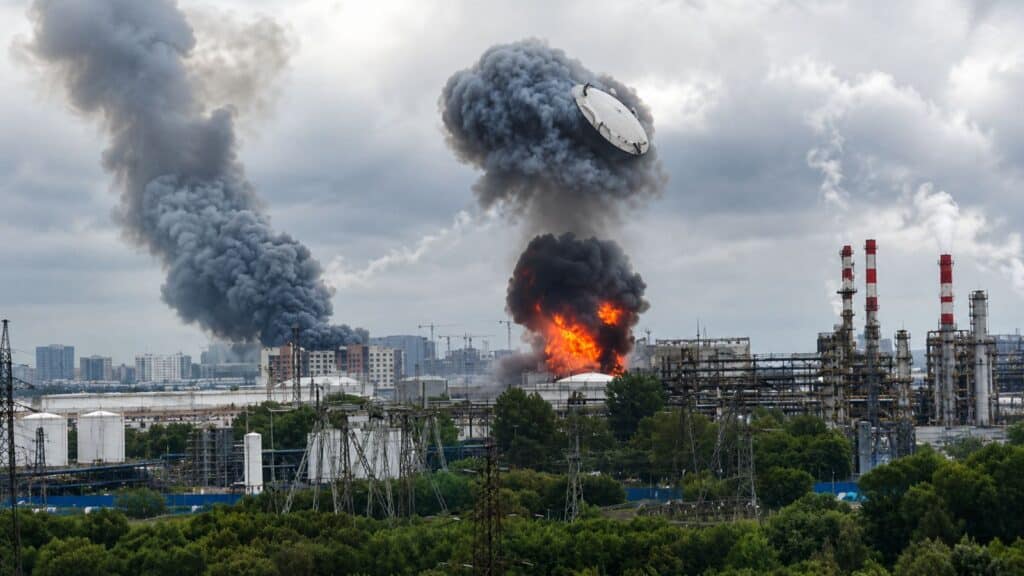
Ukraine has launched one of its largest aerial offensives of the war, sending more than 1,000 drones across Russian territory in a coordinated overnight assault that struck Moscow’s critical Kapotnya oil refinery for the second time in a week. The operation marks the biggest direct attack on the Russian capital since Moscow launched its full-scale invasion of Ukraine in February 2022, underlining a major shift in Kyiv’s long-range war strategy.
Russian authorities said around 580 drones were intercepted across multiple regions, including Moscow, Rostov, Belgorod, Bryansk, Kursk and Voronezh, but dozens penetrated air defences and hit strategic infrastructure. The strikes triggered fires, injured civilians, shut down airports and caused an immediate rise in fuel prices in the capital, exposing the growing economic and psychological cost of the war for Russia.
The attack comes at a critical diplomatic moment, with Ukrainian President Volodymyr Zelenskyy intensifying efforts to secure stronger Western backing, including renewed outreach to US President Donald Trump, as Kyiv pushes for tougher sanctions and expanded air defence support. The operation appears designed not only to damage Russian infrastructure but also to strengthen Ukraine’s leverage in the wider geopolitical struggle surrounding the war.
The Strike
Russian defence officials said the overnight operation involved more than 1,000 drones launched in waves across western and central Russia, making it one of the largest coordinated Ukrainian aerial assaults of the conflict. Moscow said approximately 580 drones were intercepted, but several broke through and reached the capital.
Explosions were reported in southeastern Moscow, particularly around the Kapotnya industrial zone. Residents described hearing multiple blasts followed by large fires at the refinery complex. Video footage from the area showed heavy flames and black smoke rising over the facility.
The wider attack stretched far beyond Moscow. Regional governors in Rostov, Belgorod, Bryansk, Kursk and Voronezh confirmed drone activity, interceptions and infrastructure damage. The scale suggests a coordinated operation aimed at stretching Russian air defences across several hundred kilometres.
At least 16 people were injured in the Moscow region, according to local authorities. Residential buildings, vehicles and commercial spaces were also damaged by falling debris.
Moscow Mayor Sergei Sobyanin said emergency crews were deployed immediately and confirmed industrial infrastructure had been hit. The Kremlin has not released a full damage assessment.
Russian President Vladimir Putin has maintained that “Russia will not back down under pressure and will continue operations until its security objectives are secured.” The scale of the latest attack is likely to increase scrutiny over the Kremlin’s internal defence systems.
Why Kapotnya Matters
The Kapotnya oil refinery is one of Moscow’s most strategically important fuel-processing facilities, supplying roughly 40% of the capital’s gasoline and around 50% of its diesel. It is central not only to civilian transport but also to military fuel logistics.
This latest strike is the second successful hit on the refinery in less than a week, indicating Ukraine may be pursuing a deliberate strategy of sustained degradation rather than symbolic attacks.
Reports suggest the latest strike damaged one of the refinery’s primary refining units — a core processing system that accounts for around 53% of the plant’s total refining capacity. That level of damage could significantly reduce fuel production and disrupt supply chains for days or weeks.
Military analysts say repeated attacks on refining infrastructure are part of Ukraine’s broader campaign to weaken Russia’s war economy. By hitting oil facilities, Kyiv aims to reduce state revenues, strain logistics and create domestic supply pressure.
President Zelenskyy defended the strikes, calling them “a justified response to Russian terror against our cities.” He added: “Every missile, every drone, every strike against our civilians will be answered.”
Kyiv has increasingly described this doctrine as “long-range sanctions” — using drones to physically disrupt Russia’s economy where traditional international sanctions have had limited effect.
Economic Shock
The impact of the attack was felt almost immediately in Russia’s fuel market.
Petrol retailer Neftmagistral raised fuel prices by nearly 19% in Moscow within hours of the refinery strike, prompting Russia’s anti-monopoly regulator to open an urgent inquiry.
The sudden price jump has become one of the clearest signs yet that Ukraine’s refinery campaign is starting to affect domestic economic stability inside Russia.
Energy experts say repeated refinery attacks force Russia into expensive repair cycles while increasing transportation costs and creating volatility in regional supply chains. Even if exports continue, domestic markets can face shortages and price spikes.
Oil remains one of the Kremlin’s most important sources of wartime funding. Disrupting refining capacity does not just affect fuel supplies; it increases operational costs across Russia’s military and civilian infrastructure.
The latest strike shows how Ukraine’s strategy is increasingly focused on turning economic pressure into a battlefield tool.
Russia Responds
Within hours of the Moscow strike, Russia launched retaliatory missile and drone attacks on Kyiv and several other Ukrainian regions.
Air raid sirens sounded across the Ukrainian capital overnight as explosions were reported in residential areas. Ukrainian officials said at least 10 people were killed and dozens injured.
Kyiv also accused Russian forces of damaging the historic Pechersk Lavra monastery complex, one of the country’s most important religious and cultural sites.
President Zelenskyy condemned the attacks, saying “Russia continues to prove that it deliberately targets civilians and our identity.”
Inside Russia, the latest Ukrainian operation has triggered sharp reactions from hardline political figures. Former Russian President Dmitry Medvedev and nationalist commentators called for harsher retaliation and broader strikes against Ukrainian command centres.
The speed and intensity of the retaliation highlight the increasingly dangerous cycle of escalation now shaping the conflict.
A New Phase
The war is entering a new phase where infrastructure, energy and public morale are becoming as important as battlefield positions.
For much of the conflict, Ukraine focused primarily on territorial defence and counteroffensives. But with frontlines increasingly stabilised in some sectors, Kyiv has expanded its drone warfare strategy deep into Russian territory.
The ability to launch over 1,000 drones across multiple regions demonstrates a major expansion in Ukraine’s domestic drone production, operational planning and strike range.
Beyond physical damage, repeated attacks on Moscow are having a growing psychological effect. For years, the Kremlin has sought to keep the war distant from everyday life in the capital. That perception is changing.
Repeated strikes on the Russian capital undermine the image of security around Moscow and increase public anxiety, while forcing the Kremlin to divert military resources to homeland defence.
At the same time, Zelenskyy is using these military operations to strengthen Ukraine’s diplomatic position. His latest push for support from Donald Trump and NATO allies reflects Kyiv’s effort to combine battlefield pressure with international leverage.
As the war enters its fifth year, it is increasingly being fought not just on the frontlines, but across oil depots, rail systems, cities and economies. That transformation may define the next stage of the conflict more than territorial maps themselves.


