

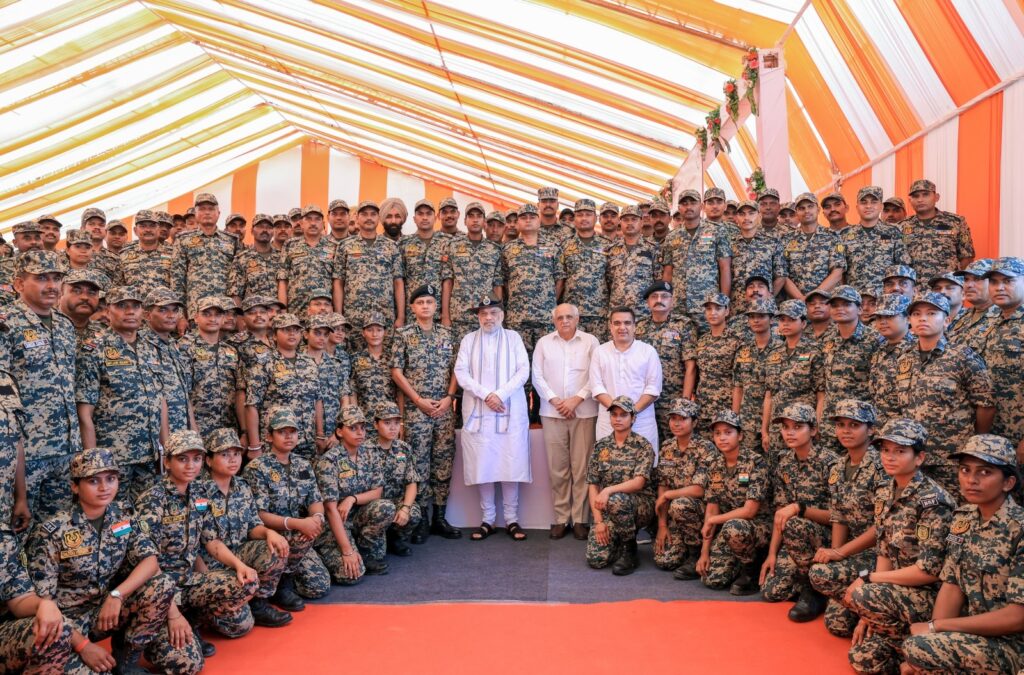
Union Home Minister Amit Shah on Friday inaugurated two new Border Security Force outposts in Gujarat’s Bhuj sector and reviewed surveillance operations in the sensitive Harami Nala and Sir Creek region along the India-Pakistan border. The visit focused on strengthening border infrastructure, expanding technological surveillance and reviewing operational preparedness in one of India’s most difficult frontier zones, where marshlands, tidal creeks and shifting terrain continue to create major security challenges for forces deployed in the region.
Shah inaugurated the G-7 and G-13 Border Out Posts, commonly known as BOPs, in the Rann of Kutch sector before travelling to Harami Nala, a creek area near Sir Creek that has historically remained vulnerable to infiltration, illegal crossings and smuggling activity. Senior officials from the Ministry of Home Affairs, the Border Security Force, the Intelligence Bureau and the Gujarat administration accompanied the Home Minister during the inspection and operational review.
Shah Reviews Security In Harami Nala Sector
The Harami Nala region near Sir Creek is regarded as one of the most operationally sensitive stretches along India’s western border with Pakistan because of its marshy terrain, shallow waterways and difficult accessibility. Large sections of the area remain submerged during tidal movements, making conventional border fencing and vehicle movement extremely difficult for security personnel.
During the visit, Shah reviewed ground surveillance systems, marine patrol operations and the deployment of advanced monitoring technology in the sector. Officials briefed him on the use of drones, radar systems, PTZ cameras and thermal surveillance equipment that have been introduced to strengthen round-the-clock monitoring in the creek region.
According to BSF officials, the force has significantly expanded infrastructure in the area over the past few years, including elevated observation posts, patrol routes, floating border posts and communication facilities designed to function in harsh environmental conditions. Personnel stationed in the sector operate in extreme weather conditions where temperatures fluctuate from intense desert heat to near-freezing winter nights.
A senior BSF officer briefed Shah on the operational difficulties in the marshland terrain and the increasing use of technology-driven monitoring systems in vulnerable creek zones. Officials also informed the Home Minister that several stretches in the Sir Creek sector cannot support permanent fencing because of shifting land patterns and tidal movement, forcing the BSF to depend heavily on electronic surveillance and marine patrol units.
Amit Shah Announces ‘Territorial Security’ Framework
Addressing BSF personnel during his interaction at the border outpost, Shah announced that the government is working towards a broader “territorial security” framework aimed at integrating local communities, civil administration, police forces, military units and border guarding agencies into a coordinated security network.
“We are going to form a security grid with a quadrangular concept and also launch a new concept of territorial security instead of border security,” Shah said during the interaction with personnel stationed in the sector.
He stated that the Border Security Force would remain the lead operational agency within the proposed framework while coordination between multiple institutions would strengthen response capability in sensitive border regions.
Shah also spoke about the Centre’s Smart Border Suraksha Project, which aims to modernise surveillance systems and improve operational infrastructure along India’s borders with Pakistan and Bangladesh. The project includes the deployment of advanced drones, high-resolution cameras, radar systems, command-and-control infrastructure and improved communication networks.
“We will erect a strong security grid involving drones, radar, watch towers, totally modern technology and jawans,” Shah said while outlining the government’s strategy for strengthening border monitoring systems.
Officials present during the review said the integrated model is intended to improve intelligence-sharing, strengthen rapid response capabilities and reduce infiltration risks in vulnerable stretches where traditional deployment methods face geographical limitations.
New BSF Outposts Strengthen Border Presence
The newly inaugurated G-7 and G-13 outposts are part of a broader effort to expand permanent BSF presence in the difficult Rann of Kutch region. Officials said the infrastructure has been developed to improve surveillance coverage, mobility and troop deployment in remote sections of the border where access remains limited for much of the year.
BSF officials informed the Home Minister that the new facilities include elevated observation structures, modern communication systems, accommodation units and logistical support infrastructure required for long-term deployment in isolated terrain. The outposts are also expected to improve coordination between ground patrol teams and marine surveillance units operating near Sir Creek.
The Border Security Force has increasingly relied on specialised units for operations in the creek sector, including its “Creek Crocodile” commandos trained for patrol and surveillance duties in shallow water and marshland environments. Fast patrol boats, amphibious vehicles and specialised navigation systems are routinely deployed in the region to monitor movement along creek channels and estuary routes.
During the review meeting, Shah was informed that nearly 70 percent of infrastructure strengthening work in the Sir Creek and Harami Nala sector has already been completed as part of the ongoing modernisation programme.
Officials also briefed him on efforts to improve living conditions for personnel stationed in the remote sector, including upgrades to communication access, drinking water facilities, medical support and operational transport systems.
Shah Interacts With BSF Personnel At Border
During his visit, Shah spent time interacting with BSF jawans deployed in the sector and received briefings on operational challenges faced during patrol and surveillance duties. Officials said the Home Minister shared tea and snacks with personnel stationed at the outposts and discussed weather conditions, deployment challenges and security preparedness in the region.
The Home Minister praised BSF personnel for operating in some of the country’s most demanding environments and acknowledged the role played by forces deployed across remote frontier regions.
“From minus 45 to plus 45 degrees, BSF is steadfastly fulfilling its duty,” Shah said while addressing personnel during the programme.
BSF personnel also briefed Shah on operational conditions in the marshland sector, including challenges linked to changing tidal routes, communication gaps during adverse weather and difficulties in maintaining surveillance across isolated creek stretches.
Officials present during the visit included Gujarat Chief Minister Bhupendra Patel, Gujarat Minister Harsh Sanghavi, senior BSF commanders and top officials from the Ministry of Home Affairs.
Border Modernisation Push Gains Momentum
The inauguration of the new outposts comes amid a broader push by the Centre to modernise India’s border management systems through surveillance technology, infrastructure expansion and integrated security coordination. Security agencies have increasingly focused on technology-driven monitoring systems in sectors where conventional fencing and troop deployment remain difficult because of terrain limitations.
Government officials said the Sir Creek and Harami Nala sector remains a strategic priority because of its location along the India-Pakistan border and its history of infiltration and smuggling-related concerns. The expansion of BSF infrastructure and surveillance capabilities in the region is part of a wider national security strategy aimed at strengthening monitoring across vulnerable frontier zones.
Officials said future upgrades in the sector are expected to include additional surveillance towers, improved marine patrol systems, advanced communication technology and expanded deployment support infrastructure for personnel operating in remote border areas.


