

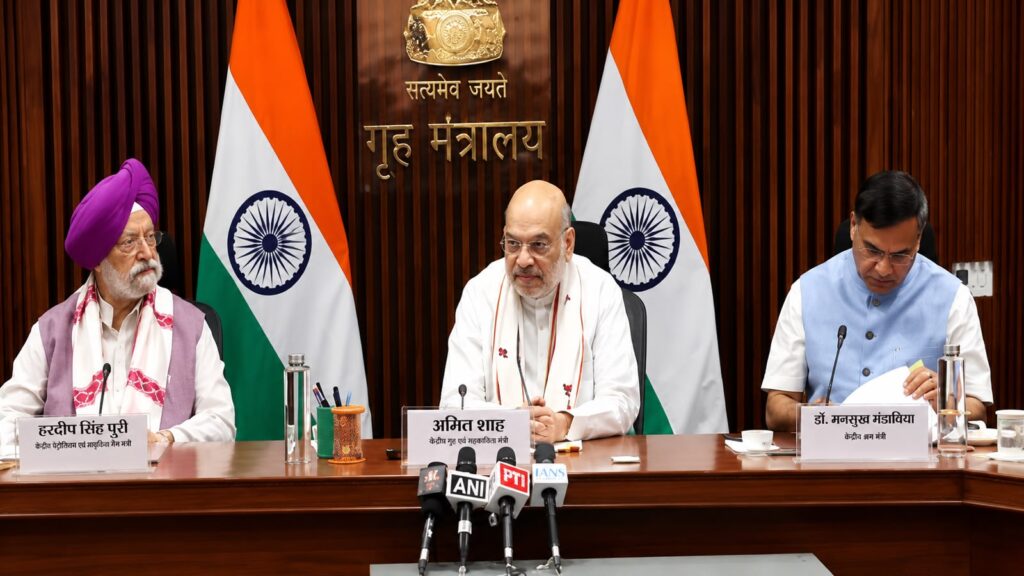
A landmark agreement between the Government of India, the Government of Assam and the Government of Nagaland has opened what officials describe as a new phase of cooperation in one of India’s most strategically important and politically sensitive regions. Signed in the presence of Union Home Minister Amit Shah, the tripartite Memorandum of Understanding (MoU) aims to facilitate the exploration and production of crude oil and natural gas along the Assam–Nagaland border, an area believed to hold substantial untapped hydrocarbon reserves.
The agreement comes against the backdrop of a decades-old interstate boundary dispute that has often hindered development and investment in the region. Rather than attempting to resolve the territorial disagreement itself, the MoU creates a framework through which both states can pursue economic development while continuing discussions on broader political and legal issues through existing channels.
Officials say the agreement could unlock fresh investment, generate employment, strengthen India’s energy security and improve infrastructure across parts of the Northeast. It is also being viewed as a confidence-building measure between Assam and Nagaland and as part of the Centre’s wider effort to promote peace and development through cooperative federalism.
A Landmark Energy Pact
The MoU establishes cooperation between the Centre, Assam and Nagaland across six key areas of the petroleum sector: exploration, production, transportation, distribution, marketing and management of crude oil and natural gas resources.
Addressing the signing ceremony, Union Home Minister Amit Shah described the agreement as a major milestone.
“Today, the Government of India, the Assam government and the Nagaland government have signed this historic MoU. This agreement will enhance the prospects for oil and natural gas exploration and strengthen cooperation among all stakeholders.”
Shah said the agreement reflected the principles of national development and cooperative governance.
“This decision reflects the spirit of Nation First and cooperative federalism.”
He also revealed that the Nagaland government had expressed willingness to expand cooperation beyond the six sectors currently covered under the agreement.
“The Chief Minister of Nagaland has also said that, apart from these six fields, the Nagaland government is willing to cooperate further.”
Officials believe the framework will improve coordination among governments, encourage investment and create a more stable environment for future energy projects.
Border Dispute Remains
The significance of the agreement is closely linked to the long-running Assam–Nagaland border dispute, one of the oldest interstate disputes in India.
The disagreement dates back to differing interpretations of colonial-era boundaries and the territorial arrangements that followed the creation of Nagaland in 1963. Over the decades, competing claims over several stretches of the interstate border have periodically resulted in political tensions, legal battles and occasional clashes.
Several parts of the border region are believed to contain valuable natural resources, including oil and natural gas deposits. However, uncertainty regarding jurisdiction and administrative control has often discouraged large-scale exploration and investment.
The new MoU does not attempt to resolve the boundary dispute. Instead, it adopts a pragmatic approach that allows both states to cooperate on resource development without compromising their respective legal positions. Supporters of the agreement argue that shared economic interests can help build trust and encourage further dialogue between the two states.
Economic Stakes
The economic implications of the agreement could be significant for both states and for India’s energy sector.
According to Amit Shah, current extraction levels in the region are estimated at around 1,000 to 1,500 barrels per day. He expressed confidence that production could increase by more than ten times under the new framework.
“The possibilities created by this agreement can increase production many times over and unlock the region’s energy potential.”
The Home Minister also highlighted the scale of the resources believed to be available in the area.
“One identified field alone has recoverable reserves estimated at more than ₹15,000 crore.”
The figure underscores the economic importance of the agreement and the potential benefits of expanding exploration activities in the border region.
Assam has long been India’s oldest oil-producing state and remains a major contributor to domestic petroleum production. Officials believe new investments could generate jobs, improve transport infrastructure, strengthen local economies and increase revenues for both governments.
Shah further indicated that the agreement could create opportunities beyond hydrocarbons.
“This cooperation can also open possibilities for future mineral exploration and mining activities.”
Analysts say successful implementation could transform a historically disputed region into a significant centre of economic activity and resource development.
Northeast Strategy
The agreement forms part of the Narendra Modi government’s broader strategy of combining economic development with political stability across the Northeast.
Over recent years, the Centre has pursued a series of peace agreements, infrastructure projects and development initiatives aimed at integrating the region more closely with the national economy. Government officials argue that improved security and economic opportunity must go hand in hand.
Amit Shah has repeatedly stressed the importance of linking peace with development.
“Development and peace must move together if the Northeast is to realise its full potential.”
Officials point to a sharp decline in violence across several parts of the Northeast in recent years, creating conditions that are more favourable for investment, infrastructure expansion and industrial growth.
The Assam–Nagaland MoU reflects this approach by encouraging cooperation instead of confrontation. It is also being seen as an example of cooperative federalism, with the Centre facilitating collaboration between neighbouring states on issues of mutual economic interest.
The Road Ahead
While the signing of the MoU marks an important political achievement, its success will ultimately depend on implementation.
Authorities will need to establish clear procedures for project approvals, environmental safeguards, revenue-sharing arrangements, security coordination and stakeholder consultations. Local communities are expected to play an important role, particularly in areas where land rights and traditional ownership remain sensitive issues.
For Assam Chief Minister Himanta Biswa Sarma and Nagaland Chief Minister Neiphiu Rio, the agreement represents an opportunity to demonstrate that cooperation can produce tangible economic benefits even when broader political disputes remain unresolved.
The Assam–Nagaland border has long symbolised some of the most enduring challenges in Northeast India. The new MoU does not settle those disputes, but it offers a framework through which economic cooperation can move forward. If implemented successfully, it could unlock significant energy resources, strengthen India’s energy security, reduce dependence on imports and provide a model for addressing other interstate challenges through dialogue and development rather than confrontation.


