

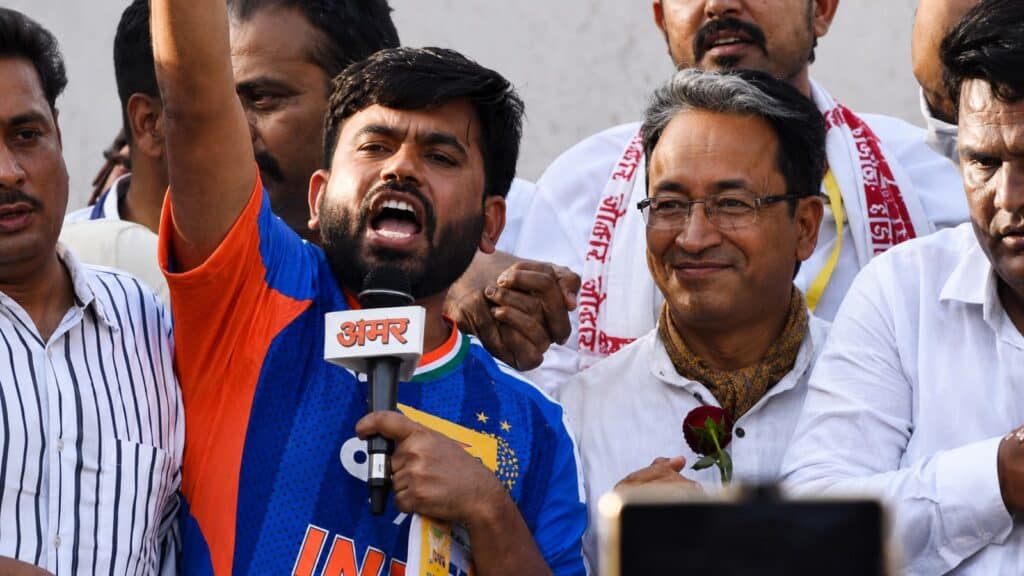
The Cockroach Janta Party (CJP) expanded its education reform campaign to Pune on Thursday, drawing hundreds of students and supporters to Savitribai Phule Pune University (SPPU) in a protest that combined demands for accountability in India’s examination system with a broader call for political attention to jobs, education and economic opportunity.
Led by founder Abhijeet Dipke, the rally marked the movement’s second major public mobilisation after its June 6 demonstration at Jantar Mantar in New Delhi. The event brought together students, activists and education reform advocates, including Sonam Wangchuk, as organisers intensified their campaign against alleged examination irregularities and renewed their demand for the resignation of Union Education Minister Dharmendra Pradhan.
The protest was defined by a slogan repeatedly raised by participants: “Hindu-Muslim ki rajneeti nahi chalegi, nahi chalegi.” Organisers said the message reflected growing frustration among young people who want greater focus on education, employment, technological innovation and economic development rather than political polarisation.
The Pune rally also saw the release of the Cockroach Janta Party’s first education manifesto and the announcement of a nationwide protest campaign that will culminate in a major mobilisation in New Delhi later this month.
Youth Anger Reaches Pune
Organisers chose Pune because of its status as one of India’s leading educational centres. Thousands of students study in the city, making it a symbolic location for a movement built around concerns over examinations, recruitment processes and educational opportunities.
Students began gathering near the Ambedkar Statue on the university campus carrying placards demanding transparency, accountability and reforms to testing systems. Participants argued that repeated allegations of paper leaks, administrative lapses and examination irregularities had weakened trust in institutions responsible for conducting competitive tests.
Addressing the crowd, Dipke said students were paying the price for systemic failures. “When examination systems fail, it is students who suffer. Years of preparation and the sacrifices made by families are put at risk when institutions fail to protect the integrity of examinations,” he said.
Organisers repeatedly instructed supporters to maintain discipline and ensure the demonstration remained peaceful, emphasising that the campaign was intended to pressure policymakers through democratic engagement rather than confrontation.
Beyond Identity Politics
Dipke argued that India’s future would be shaped by investments in education, artificial intelligence, semiconductor manufacturing, clean energy and job creation rather than debates centred on religious divisions.
“Young people want jobs, opportunities and quality education. They want India to lead in innovation and technology. These are the issues that will define the future of the country,” he told supporters.
The slogan “Hindu-Muslim ki rajneeti nahi chalegi” became the rallying cry of the event, with participants saying they wanted public debate to focus more on employment and education. Dipke also encouraged greater civic participation among students and urged families to support young people who wish to engage in public affairs.
“Let your children protest. Let them ask questions. Let them participate in democracy because the future belongs to them,” he said.
The remarks reflected the movement’s effort to expand beyond examination-related grievances and position itself as a broader youth-led campaign focused on governance and economic opportunity.
Education Reform Agenda
A central feature of the Pune rally was the release of the Cockroach Janta Party’s education manifesto, which outlines five key demands aimed at reforming India’s examination system.
The document calls for stronger safeguards against paper leaks, greater transparency in testing and evaluation processes, accountability mechanisms for examination authorities, compensation for students affected by irregularities and structural reforms designed to prevent future controversies.
The manifesto also advocates independent audits of examination systems, improved grievance redressal mechanisms and wider use of technology to strengthen monitoring and oversight.
Dipke argued that the problems facing students were not limited to isolated incidents.
“The issue is not one examination or one paper leak. The issue is a system that repeatedly fails students. Reform must be structural, transparent and permanent,” he said.
The movement continues to demand the resignation of Education Minister Dharmendra Pradhan, arguing that accountability must accompany institutional reform if public confidence is to be restored.
Supporters contend that examination integrity has become a national issue because it affects educational opportunities, employment prospects and trust in public institutions.
Wangchuk Backs Campaign
The participation of education reform advocate Sonam Wangchuk gave the Pune protest additional visibility and broadened its appeal beyond student groups.
Wangchuk, who has long advocated educational innovation and governance reforms, supported calls for greater transparency and accountability. Organisers said his involvement highlighted the growing concern among civil society groups about the credibility of examination systems and the need for institutional reform.
His participation also underscored the movement’s effort to connect education-related grievances with wider debates about governance and public trust.
For supporters, Wangchuk’s endorsement represented recognition that concerns about examinations and accountability extend beyond university campuses and affect broader sections of society.
March Towards Delhi
The Pune rally served as the launchpad for the next phase of the movement’s expansion. Organisers announced plans for demonstrations in Lucknow, Jaipur, Amritsar and Bengaluru before returning to New Delhi on June 20 for what they have called “Jantar Mantar 2.0.”
The Delhi mobilisation is being presented as the culmination of the campaign and the largest test yet of the movement’s ability to convert online support into sustained public action.
Dipke said the organisation would continue pressing its demands until it receives a response from authorities.
“Pune is only one step. We will continue travelling across India, speaking to students and raising these issues until they receive the attention they deserve,” he said.
The Pune event also highlighted the Cockroach Janta Party’s transformation from a viral social media movement into a structured political organisation. Within weeks of its emergence, the group has become one of the country’s most closely watched youth-led campaigns, drawing attention from students frustrated by examination controversies, unemployment and concerns about accountability.
Whether the organisation can convert that momentum into lasting political influence remains uncertain. However, the scenes at Savitribai Phule Pune University demonstrated that issues surrounding education, employment and governance continue to resonate strongly with a significant section of India’s youth.
For many participants, the message from Pune was straightforward: India’s future should be shaped by opportunity, education and economic progress rather than division. As the movement prepares for its next demonstrations and a return to Delhi, that message is likely to remain at the centre of its campaign.


