

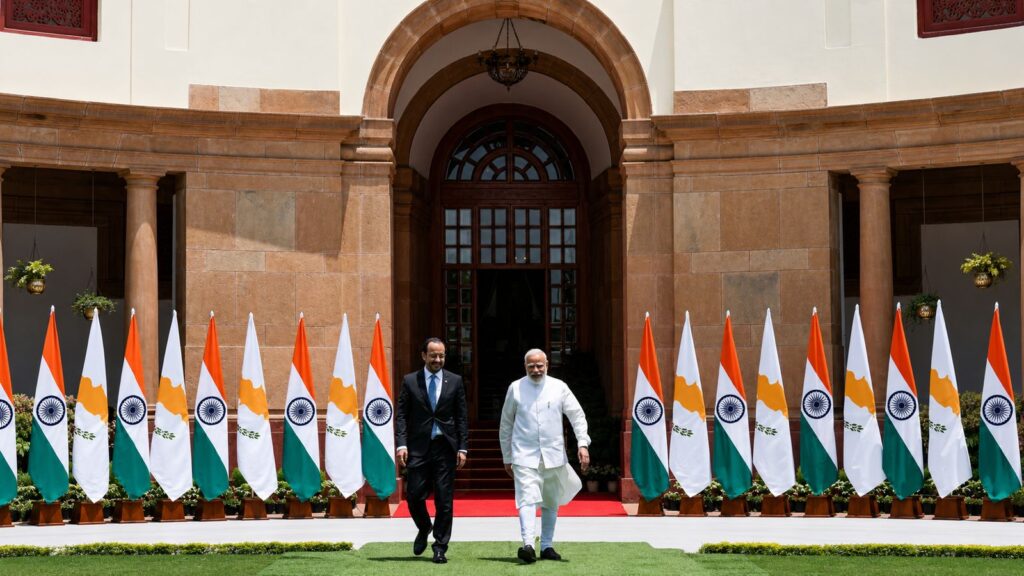
India and Cyprus on Thursday elevated their bilateral relationship to a strategic partnership after Prime Minister Narendra Modi held high-level talks with Cypriot President Nikos Christodoulides in New Delhi, resulting in six major agreements covering defence, counter-terrorism, cybersecurity, maritime coordination, education, culture and diplomatic cooperation. The summit marked one of the most significant diplomatic engagements between the two countries in recent decades and reflected India’s expanding strategic outreach toward Europe and the Mediterranean region at a time of growing geopolitical uncertainty, supply chain disruptions and rising competition over global trade corridors.
The agreements were signed during Christodoulides’ first official visit to India as president from May 20 to 23. The visit came less than a year after Modi’s landmark trip to Cyprus in June 2025, the first by an Indian prime minister in more than twenty years, which both governments described as a turning point in bilateral ties.
Officials from both countries said the new partnership framework would deepen long-term coordination in security, trade, technology, maritime affairs and international diplomacy. The summit also highlighted India’s broader strategy of building stronger relations with strategically positioned European nations as New Delhi seeks greater geopolitical and economic influence beyond Asia.
Strategic Partnership
The decision to elevate India-Cyprus relations to a strategic partnership represents a major shift in bilateral diplomacy, moving the relationship beyond traditional economic engagement toward deeper political, defence and strategic coordination.
The two leaders agreed to institutionalise regular cooperation through foreign office consultations, defence dialogues, cybersecurity engagement, economic coordination mechanisms and maritime cooperation platforms. Officials said the partnership would strengthen cooperation between ministries, security agencies, universities, shipping authorities and business institutions in both countries.
Speaking after the talks, Modi described Cyprus as an important strategic partner for India in the Mediterranean region and said the relationship was entering a “new phase of cooperation.”
“India and Cyprus have decided to strengthen and give strategic direction to our partnership. Our cooperation will expand across defence, trade, maritime security, technology and innovation,” Modi said.
Christodoulides said Cyprus viewed India as an emerging global power with growing influence across international institutions and strategic trade networks.
“Our partnership is built on trust, shared democratic values and a common commitment to stability, security and prosperity,” the Cypriot president said.
The two leaders also reaffirmed support for international law, maritime stability and multilateral cooperation while emphasising the importance of secure trade routes and regional connectivity.
Diplomatic analysts said the strategic partnership reflects India’s growing effort to deepen ties with European Union member states while expanding its geopolitical presence in the Mediterranean region.
Defence And Security
Defence and security cooperation emerged as one of the central outcomes of the summit, with both countries unveiling a defence cooperation roadmap extending through 2031.
The roadmap includes expanded cooperation in maritime security, naval coordination, military training, defence industry collaboration, cybersecurity and joint search-and-rescue operations. Officials said the framework would create long-term operational coordination between defence institutions in both countries.
India and Cyprus also established a Joint Working Group on Counter-Terrorism focused on intelligence sharing, terror financing investigations, cyber extremism, organised crime and transnational security threats.
The agreement carries strategic significance for India as New Delhi continues to expand international counter-terrorism partnerships amid growing concern over cyber threats and extremist financing networks.
“Terrorism remains one of the gravest threats facing the international community. India and Cyprus agree that there can be no justification for terrorism in any form,” Modi said during the joint statements.
Cyprus reiterated support for India’s position on global counter-terrorism efforts and backed stronger international coordination against extremist networks.
A separate agreement was signed between Cyprus’ Larnaca Joint Rescue Coordination Center and India’s Ministry of Defence to improve maritime emergency response coordination and rescue operations in international waters.
Officials said the agreement would strengthen operational cooperation across strategically important sea lanes connecting Europe, West Asia and Asia.
The summit also saw the launch of an India-Cyprus Cyber Security Dialogue focused on digital infrastructure protection, cyber resilience, financial technology security and cybercrime prevention.
Cybersecurity has become an increasingly important area of international cooperation as governments worldwide face rising threats targeting banking systems, communication infrastructure and public networks.
Trade And Investment
Economic cooperation formed another major pillar of the summit discussions as both sides agreed to deepen trade and investment ties across technology, infrastructure, shipping, renewable energy and financial services.
One of the major announcements was the establishment of a Cyprus Trade Center in Mumbai aimed at promoting investment opportunities and commercial partnerships between businesses in both countries.
Cyprus already ranks among the top ten sources of foreign investment into India due to its role as an international financial and shipping hub. Indian officials said the new framework is expected to accelerate investment activity and create fresh opportunities for bilateral business expansion.
Modi said investment flows from Cyprus into India had nearly doubled over the past decade, reflecting growing economic confidence between the two countries.
“Economic cooperation between India and Cyprus has witnessed strong momentum. There are immense opportunities in shipping, digital innovation, infrastructure and technology,” Modi said.
Officials from both countries also discussed expanding cooperation in fintech, startup ecosystems, artificial intelligence and digital infrastructure projects.
Cyprus’ strategic position within the European Union is expected to provide Indian businesses greater access to European markets, particularly in sectors such as information technology, pharmaceuticals, logistics and financial services.
For Cyprus, stronger ties with India offer access to one of the world’s fastest-growing major economies and a rapidly expanding consumer market.
Economic experts said the partnership reflects India’s broader effort to diversify international investment relationships and reduce dependence on traditional trade corridors amid shifting global supply chains.
Maritime And Connectivity
Maritime cooperation emerged as one of the most strategically important aspects of the summit due to Cyprus’ location near critical Mediterranean shipping routes and India’s growing focus on global maritime connectivity.
In a major development, Cyprus joined India’s Indo-Pacific Oceans Initiative under the pillar of Trade, Connectivity and Maritime Transport, becoming one of the few European countries associated with the initiative.
The move is expected to strengthen India’s maritime outreach toward Europe while expanding cooperation in shipping, logistics and trade corridor development.
Officials said the partnership would support greater collaboration in merchant shipping, port infrastructure, maritime logistics and supply chain resilience.
Cyprus possesses one of the world’s largest merchant shipping fleets and remains a major maritime hub linking Europe, West Asia and North Africa. India, meanwhile, has accelerated investments in ports and shipping infrastructure under its wider economic and connectivity strategy.
The two countries also stressed the importance of secure and uninterrupted maritime trade routes amid ongoing geopolitical tensions affecting international shipping corridors.
“Free, secure and stable sea routes are essential for global economic growth and regional stability,” Christodoulides said during the summit.
Strategic analysts said India increasingly views Mediterranean partnerships as essential to its long-term economic and geopolitical ambitions because of the region’s role in connecting Asian trade routes with European markets.
The maritime agreements signed during the visit are also expected to support India’s efforts to strengthen its presence across key international logistics and shipping networks.
Diplomacy And Cultural Links
Beyond defence and trade, the summit also focused heavily on diplomatic, educational and cultural cooperation aimed at strengthening long-term people-to-people engagement between the two countries.
India and Cyprus signed an agreement between the Sushma Swaraj Institute of Foreign Service and the Cyprus Diplomatic Academy to expand diplomatic training exchanges and policy cooperation.
Officials said the initiative would improve institutional coordination between the two foreign ministries and help strengthen long-term administrative engagement.
The two countries also established a Consular Dialogue mechanism focused on visa facilitation, legal cooperation and mobility for professionals and students.
Education agreements signed during the summit are expected to promote university partnerships, academic exchanges and research collaboration in technology and innovation sectors.
India additionally gifted a BHISM Cube to Cyprus as part of its humanitarian assistance and health diplomacy outreach. BHISM, which stands for Bharat Health Initiative for Sahyog Hita and Maitri, is a mobile emergency medical assistance platform designed for disaster relief and humanitarian response operations.
The initiative reflects India’s increasing use of development partnerships and humanitarian diplomacy as part of its wider global engagement strategy.
The two leaders also reaffirmed mutual support on key international issues. Cyprus reiterated support for India’s long-standing bid for a permanent seat on the United Nations Security Council, while India backed a peaceful reunification of Cyprus in accordance with United Nations resolutions and international law.
Officials said the summit ultimately reflected the growing convergence between India and Cyprus across security, trade, maritime strategy and international diplomacy as both countries seek stronger partnerships in an increasingly uncertain global environment.


