

Across India, a series of intense and deeply emotional protests are unfolding, cutting across geography, identity and cause, yet bound together by a strikingly similar sense of neglect. From the violence-hit streets of Imphal to the riverbanks of Chhatarpur and the forested hills of Rayagada and Kalahandi, communities are not just protesting specific incidents or policies. They are raising deeper, more uncomfortable questions about visibility, equality and state response.
What is unfolding is not a single crisis but a pattern. In each of these regions, people say they are being pushed to the margins of national attention, forced to protest in extreme, symbolic ways just to be acknowledged. The anger is no longer only about justice, land or rights. It is about a growing perception that unless suffering reaches a certain political or geographic threshold, it does not trigger urgency at the highest levels of power. In that sense, these protests are as much about being heard as they are about the issues themselves.
Manipur: “Is Manipur Even Part of India?”
In Manipur, fresh protests erupted after the April 7 bombing in Tronglaobi Awang Leikai near Moirang, where suspected militants hurled explosives at a home, killing two children and injuring their mother. The attack has reignited anger in a state already grappling with a prolonged crisis that has disrupted everyday life for over three years.
Torch rallies have drawn thousands onto the streets of Imphal, where demonstrators carrying flames have marched in mourning and defiance. Security forces blocked their movement near Keishamthong Bridge, using tear gas to disperse crowds, a move that further intensified tensions.
Tensions escalated further when protesters alleged that security forces blocked a peace rally at Sagolband and used force, including tear gas and other crowd-control measures, leaving several demonstrators injured. The claims have added to anger on the ground, though officials have maintained that actions were taken to control the situation.
Amid the protests, a young man’s question to the Prime Minister captured the depth of frustration:
“If there is a terrorist attack in Gujarat, Rajasthan, UP or Delhi, I know you will do an airstrike and eliminate those terrorists. But why not in Manipur?”
The question resonated widely, reflecting a belief that responses to violence are not uniform across the country.
Others went further, voicing a sentiment that has become increasingly visible in protest spaces:
“Is Manipur really a part of India? Why does it not feel like it? Why is the Prime Minister not looking into it?”
Another protester sharply criticized what he described as selective political narratives:
“You focus only on Dhurandar’s success. Why remain silent on Manipur’s three-year crisis that has destroyed our youth and student lives? A mother’s grief over her slain child is no ‘women’s empowerment.’”
For many, these protests are no longer about a single incident. They are about accumulated grief, fear and a perception of abandonment.
Authorities maintain that security operations are ongoing and stress the need to maintain order. But on the ground, the reliance on crowd control measures without visible political outreach has deepened mistrust.
Madhya Pradesh: “Burn Us Here or Save Us”
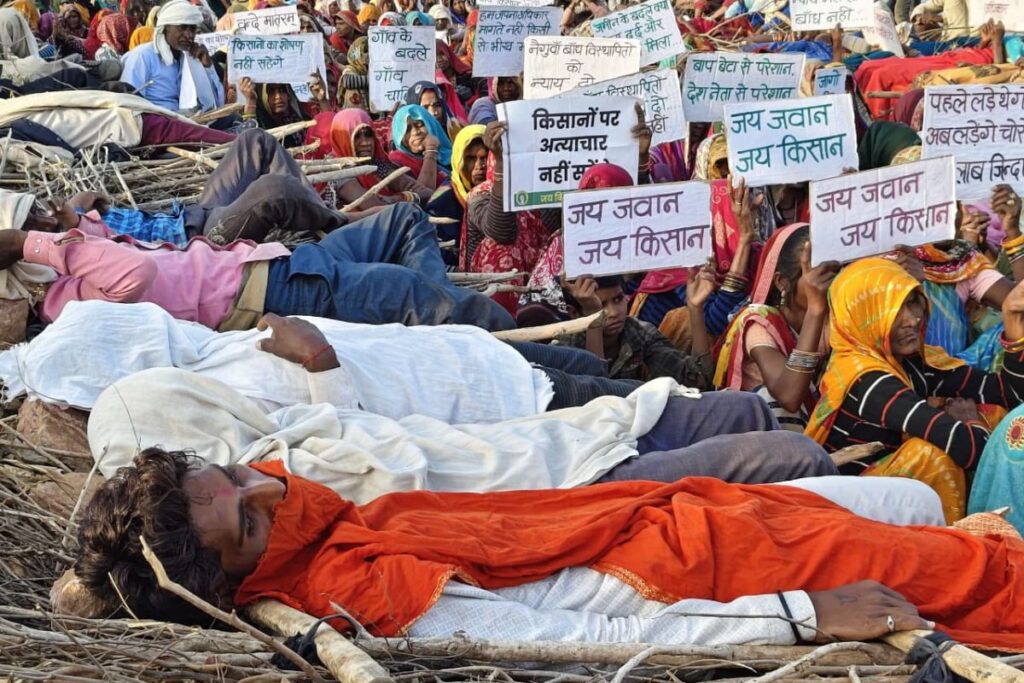
In Chhatarpur, the protest has taken a form that is both quiet and profoundly unsettling. Tribal farmers are resisting the Ken-Betwa River Linking Project, particularly the Daudhan Dam, which they say will submerge their homes and lands.
The “Chita Andolan” has become the defining image of this resistance. Protesters lie on symbolic funeral pyres, declaring that displacement without dignity is equivalent to death. Many are women, some accompanied by children, underscoring the human cost of the project.
An Adivasi woman explained the reason behind their protest in simple terms:
“Our forests, land, and homes are being taken away, so we are forced to protest. It’s been 10 days.”
The agitation also includes Jal Satyagraha and Mitti Satyagraha, reinforcing the deep connection between the community and its environment.
The government has defended the project as essential for water security in Madhya Pradesh and Uttar Pradesh, offering compensation and rehabilitation. However, protesters argue that these measures are inadequate and lack transparency.
Concerns over environmental impact, particularly on the Panna Tiger Reserve, have further fueled opposition. For those on the ground, the protest is not just about land acquisition. It is about identity, survival and dignity.
Odisha: “Our Hills Are Not for Sale”
In Rayagada and Kalahandi, tribal communities are mobilizing against bauxite mining linked to Vedanta Limited, reviving a long-running struggle over land, identity and resources.
Recent gatherings have seen villagers take collective oaths in the names of Birsa Munda and B. R. Ambedkar, pledging not to allow mining on their hills. The symbolism reflects both cultural resistance and a constitutional assertion of rights.
“We will not give our hills. This is our land, our identity, our future,” one protester said, capturing the mood on the ground.
For these communities, the hills are sacred landscapes, central to their way of life. Mining, they argue, would lead to displacement, environmental degradation and the loss of livelihoods tied to forests and agriculture.
Despite legal safeguards requiring Gram Sabha consent, protesters remain wary. Many say past experiences have eroded trust in how such approvals are obtained.
Tensions have begun to rise, with reports of confrontations between villagers and security personnel. Protesters allege that instead of dialogue, their resistance is being met with pressure.
The state government continues to balance development priorities with legal obligations, but there has been no immediate outreach to address current concerns.
For many here, the protest is not just about stopping a project. It is about defending identity, rights and existence in the face of repeated uncertainty.
The Question That Refuses to Fade
Across these regions, the message is no longer fragmented. It is converging into a single, uncomfortable question.
If citizens across different states, backgrounds and struggles are all asking to be heard, why do they feel unheard?
From the torchlit streets of Manipur to the funeral pyres of Madhya Pradesh and the oath-bound hills of Odisha, the protests continue. Not just as resistance, but as a demand for recognition.
Because for many standing on those frontlines, the issue is no longer just justice, land or rights.
It is whether their voice matters at all!?


