

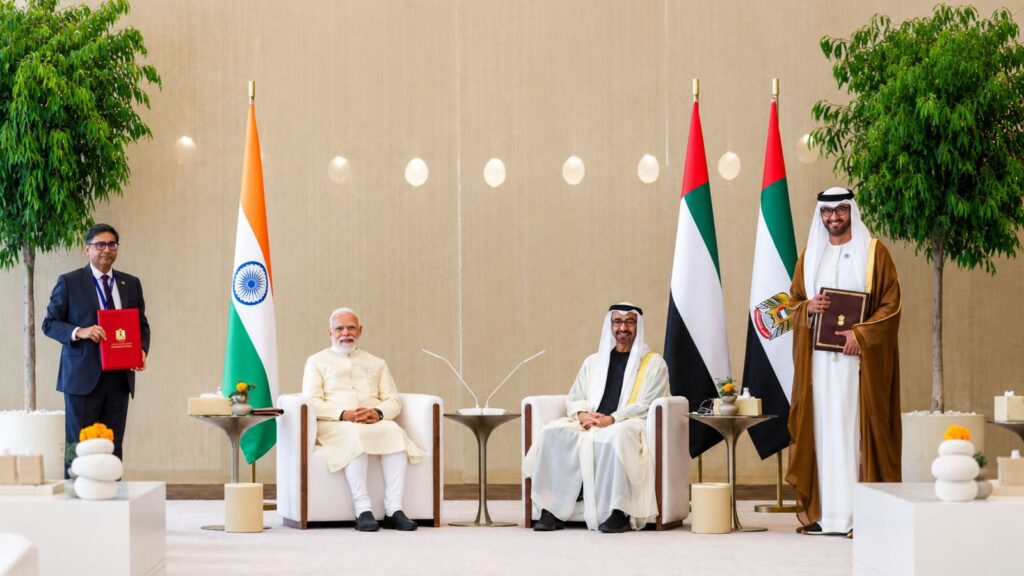
Indian Prime Minister Narendra Modi concluded a short but strategically significant visit to the United Arab Emirates on Friday with a series of major agreements spanning defence, energy security, maritime infrastructure and advanced technology, alongside a $5 billion investment commitment from Abu Dhabi.
Although the visit lasted barely two-and-a-half hours, it produced seven major agreements that officials described as a turning point in the rapidly expanding India-UAE partnership. The discussions took place against the backdrop of rising instability in West Asia, fears of oil supply disruptions and growing concerns over the security of the Strait of Hormuz, one of the world’s most critical shipping routes for crude oil.
The visit began with rare diplomatic symbolism. UAE President Sheikh Mohamed bin Zayed Al Nahyan personally received Modi at Abu Dhabi airport, while UAE F-16 fighter jets escorted the Prime Minister’s aircraft into Emirati airspace before he was accorded a ceremonial guard of honour. The gestures reflected the increasingly close strategic and personal ties between the two leaders.
In a post on social media platform X, Modi wrote, “I thank my brother HH Sheikh Mohamed bin Zayed Al Nahyan, President of the UAE, for the special gesture of receiving me at Abu Dhabi airport. I look forward to our discussions towards furthering India-UAE ties across key sectors like energy, investment, supply chains and more.”
Defence Pact
The most significant outcome of the visit was the signing of an “Agreement on Framework for the Strategic Defence Partnership”, which substantially upgrades military and security cooperation between India and the UAE.
The agreement moves India-UAE ties far beyond their traditional focus on trade and oil imports. Officials said the framework would strengthen cooperation in defence manufacturing, maritime security, cybersecurity, intelligence-sharing, military training, secure communications, joint exercises and advanced defence technologies.
The agreement comes at a time of mounting geopolitical tensions across the Gulf region, particularly following the ongoing Iran conflict and recent attacks targeting the UAE. Analysts view the defence pact as part of India’s broader effort to expand its strategic footprint in West Asia and secure critical maritime routes linked to energy imports and global trade.
Speaking during delegation-level talks, Modi stressed that India-UAE strategic cooperation had gained far greater importance amid the current global environment. He said, “In the kind of situation we have at hand today, the importance of India-UAE strategic cooperation has vastly increased.”
The agreement also reflects the UAE’s evolving foreign policy strategy as it diversifies defence partnerships beyond traditional Western allies.
Security Concerns
A major diplomatic moment during the visit came when Modi strongly condemned recent attacks targeting the UAE and publicly aligned India with Emirati security concerns.
Modi said, “India stands shoulder-to-shoulder with UAE in every situation.” He further added, “The manner in which UAE has been targeted is not acceptable in any form.”
The remarks are significant because India has historically been cautious in publicly commenting on Gulf security conflicts. Modi’s strong language signalled growing strategic trust between New Delhi and Abu Dhabi during a period of heightened instability in West Asia.
The Prime Minister also emphasised the importance of protecting global shipping routes and maintaining freedom of navigation through the Strait of Hormuz. Modi stated, “The Strait of Hormuz must remain free and open.”
The comments carried major geopolitical significance because nearly one-fifth of global oil shipments pass through the narrow waterway. Any disruption there could sharply impact global energy markets and economies heavily dependent on crude imports, including India.
Energy Security
Energy cooperation formed another major pillar of the visit as India sought to secure stable fuel supplies amid volatility triggered by the Iran conflict and fears of disruptions to Gulf shipping lanes.
India and the UAE signed a Memorandum of Understanding on Strategic Petroleum Reserves designed to strengthen India’s emergency crude storage capabilities and shield the country from supply shocks.
The agreement builds on an existing arrangement under which Abu Dhabi National Oil Company became the only foreign company storing crude oil inside India’s underground strategic reserves in 2018. India currently has strategic reserve capacity of around 5.33 million metric tonnes and is planning a major expansion in the coming years.
Under the new agreement, ADNOC may expand its storage presence and potentially store up to 30 million barrels of crude oil in India, strengthening long-term energy cooperation between the two countries.
India also finalised a major LPG supply agreement between Indian Oil Corporation and ADNOC aimed at ensuring long-term, prioritised fuel supplies for Indian consumers. The UAE already fulfils a substantial share of India’s LPG demand, making the agreement strategically important for domestic energy stability and inflation management.
The agreements highlight India’s broader push to diversify and secure long-term energy imports as global oil markets remain vulnerable to geopolitical tensions.
Another major geopolitical factor influencing the discussions was the UAE’s recent exit from OPEC, which gives Abu Dhabi greater flexibility to increase oil production independently of cartel production limits.
For India, the development is strategically valuable because it potentially allows the UAE to provide more stable and expanded crude supplies during periods of global market disruption. India, the world’s third-largest energy importer, has been seeking reliable long-term suppliers capable of insulating its economy from price shocks linked to geopolitical crises.
Investment Push
Alongside the strategic agreements, the UAE announced investments worth $5 billion in Indian infrastructure and financial institutions.
According to reports, the investment commitments include:
- Infrastructure investments in partnership with India’s National Investment and Infrastructure Fund (NIIF)
- A proposed $3 billion investment linked to RBL Bank
- A proposed $1 billion investment in housing finance firm Sammaan Capital
The announcements further strengthen the UAE’s role as one of India’s most important economic partners and foreign investors.
Bilateral trade between India and the UAE has already crossed $100 billion annually following the implementation of the Comprehensive Economic Partnership Agreement, which accelerated trade and investment flows between the two countries. Both sides are now targeting bilateral trade worth $200 billion in the coming years.
AI and Maritime Deals
The visit also produced significant agreements in maritime infrastructure and advanced technologies.
India signed an MoU with UAE-based Drydocks World to establish a Ship Repair Cluster at Vadinar in Gujarat, a project expected to strengthen India’s maritime ecosystem and support the government’s ambitions to turn the country into a major logistics and shipping hub.
Officials believe the project could generate employment, expand industrial activity and improve India’s domestic ship repair capabilities along its western coast.
Another major development involved artificial intelligence and high-performance computing.
India’s Centre for Development of Advanced Computing and UAE technology company G42 signed a term sheet for the development of an eight-exaflop supercomputing cluster under India’s AI Mission.
The project is expected to significantly boost India’s AI computing capacity and reflects how India-UAE ties are expanding into emerging technologies, digital infrastructure and advanced innovation sectors.
Wider Geopolitics
The visit also carried wider geopolitical implications beyond bilateral relations.
The agreements come at a time when Pakistan has been expanding defence cooperation with Saudi Arabia while also playing a mediation role between Tehran and Washington during the ongoing regional crisis.
Against this backdrop, India’s strengthening partnership with the UAE reflects New Delhi’s effort to maintain strategic balance and influence in the Gulf region, which remains crucial for energy supplies, trade routes and diaspora interests.
More than 4.5 million Indians live and work in the UAE, making it one of the largest Indian expatriate communities in the world. Modi thanked the UAE leadership for its continued support and care for the Indian community during his discussions with Sheikh Mohamed bin Zayed.
At the conclusion of the visit, Modi described the trip as “short but highly productive” and expressed confidence that the agreements would deepen friendship, strengthen strategic cooperation and contribute to long-term prosperity for both nations.
As instability reshapes West Asia and energy security becomes an increasingly urgent global concern, the agreements signed in Abu Dhabi indicate that India and the UAE are rapidly evolving into long-term strategic allies with growing influence across defence, technology, infrastructure and regional geopolitics.


