

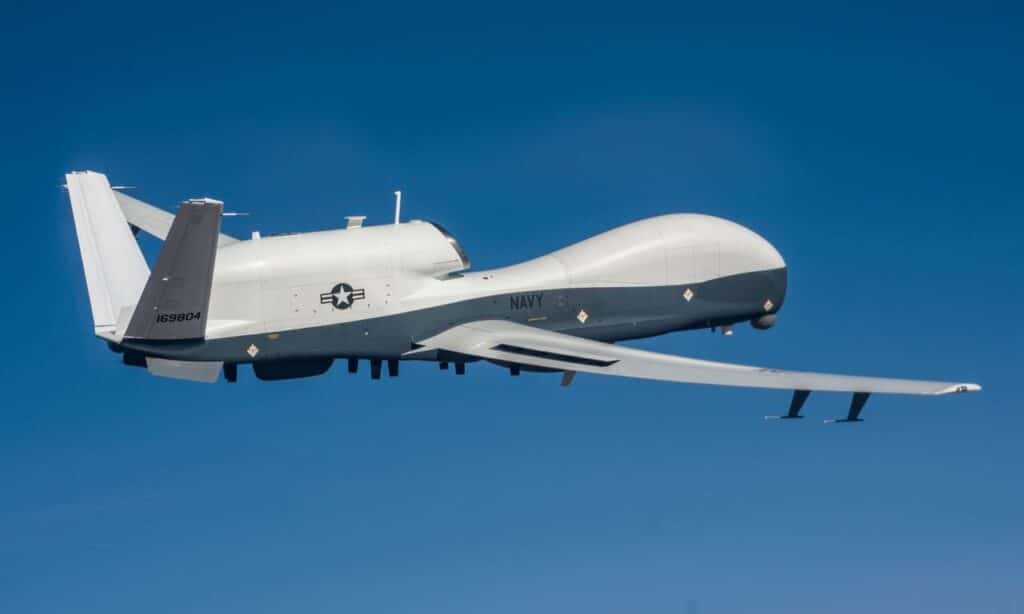
The reported disappearance of a U.S. Navy MQ-4C Triton over the Strait of Hormuz has drawn attention to military activity in one of the world’s most sensitive maritime corridors.
According to multiple media reports and flight-tracking data reviewed by open-source intelligence observers, the high-altitude surveillance drone transmitted an emergency distress signal before vanishing from publicly available monitoring systems. The United States Navy has not confirmed the incident. “There has been no official comment from the U.S. Navy or the Department of Defense on the reported incident.”
The development comes amid ongoing tensions between the United States and Iran, where surveillance operations and military activity have increased in recent weeks.
Flight Timeline
Available flight data, based on open-source tracking platforms and widely cited by international media outlets, provides a reconstruction of the drone’s final recorded movements.
The Triton was operating at approximately 52,000 feet, consistent with its standard operational altitude. During the mission, it was observed flying a looping patrol pattern between Iranian and Omani airspace boundaries, a route commonly associated with maritime surveillance in the Gulf region.
At one stage, the aircraft transmitted a “7700” squawk code, a universally recognised signal indicating a serious in-flight emergency. Within minutes, the drone descended sharply to around 12,750 feet. Shortly after, it disappeared from publicly available tracking systems. No further signals were recorded.
Aviation data available through civilian tracking networks does not indicate the aircraft’s status beyond that point. Military aircraft can operate with limited or no public tracking visibility, and such data does not provide a complete operational picture.
Mission Profile
The MQ-4C Triton is a high-altitude, long-endurance unmanned aircraft developed for maritime intelligence, surveillance, and reconnaissance operations.
It is capable of operating for more than 30 hours at altitudes exceeding 50,000 feet. The platform is equipped with radar and sensor systems designed to monitor large maritime areas, track vessel movement, and relay real-time information to naval command units.
The drone is typically deployed in regions of strategic importance, including the Strait of Hormuz, where it is used to monitor commercial shipping routes and regional naval activity. The reported flight pattern suggests the aircraft was engaged in a routine surveillance mission at the time of the incident.
Such operations are part of broader efforts to maintain situational awareness in the Gulf, particularly during periods of heightened regional tension.
Causes Under Review
The cause of the reported disappearance has not been confirmed, and no official statement has been issued by U.S. defence authorities.
Several possibilities have been cited in media reports and by analysts, though none have been verified.
A technical issue remains one potential explanation. The transmission of the 7700 emergency code indicates a serious onboard problem, which could involve system failure or loss of control.
Electronic interference is another possibility. The region has seen increased use of signal disruption techniques, including GPS interference and communication jamming, which can affect unmanned systems.
A kinetic incident has also been referenced in some reports. In 2019, Iran shot down a U.S. surveillance drone in the same region, an event that led to heightened tensions with the United States.
There has been no claim of responsibility or confirmation of any such action in the current case.
Another possibility is that the aircraft is no longer visible on civilian tracking systems. Military aircraft can operate without transmitting data detectable by public platforms, and disappearance from such systems does not necessarily confirm loss. “Officials have not publicly confirmed whether the aircraft was lost or simply no longer visible on tracking systems.”
Regional Context
The Strait of Hormuz is a key maritime route connecting the Persian Gulf to global markets. A significant portion of the world’s oil supply passes through the waterway, making it a focal point for international shipping and security operations.
The region has seen increased military presence in recent months, including surveillance flights, naval deployments, and heightened monitoring of commercial vessels.
Tensions between the United States and Iran have contributed to a more active operational environment, with both sides maintaining a visible presence in and around the Gulf.
The use of unmanned systems has become a regular feature of these operations, particularly for surveillance and reconnaissance purposes.
No disruptions to commercial shipping linked to the reported incident have been confirmed.
Current Status
There has been no official confirmation regarding the status of the MQ-4C Triton.
The United States Navy and the United States Department of Defense have not issued public statements addressing the reported disappearance. No debris, recovery operation, or additional flight data has been disclosed. Donald Trump has also not made any public comment on the incident.
The situation remains based on open-source reporting and has not been independently confirmed by U.S. authorities. Further details are expected if and when official information is released.


