

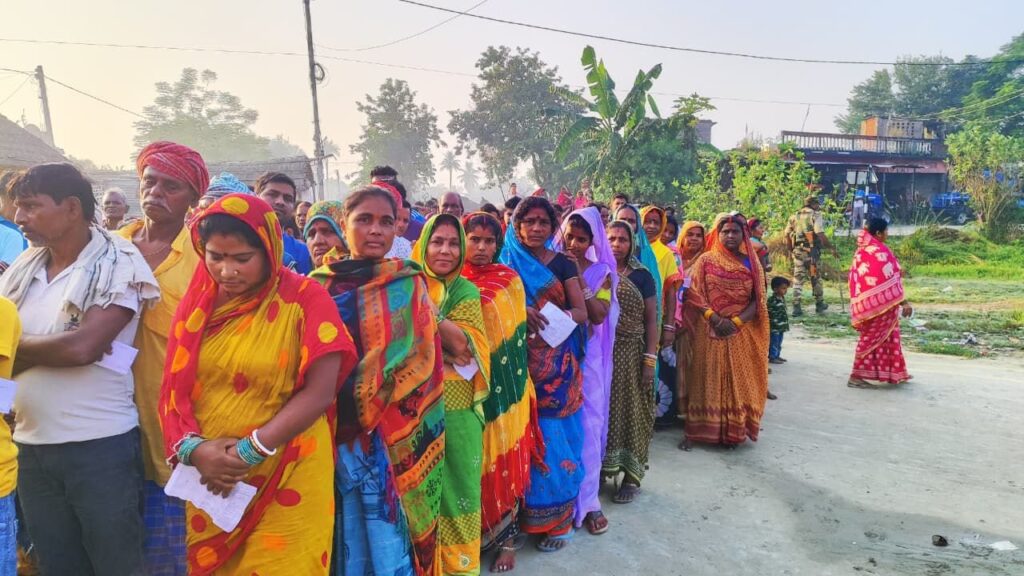
Bihar Election Phase 1 2025 commenced today, November 6, marking a crucial democratic exercise as voters across 121 constituencies in 18 districts head to polling stations. With around 3.75 crore registered voters and 1,314 candidates in the fray, this first phase sets the tone for a high-stakes political contest between the ruling National Democratic Alliance (NDA) and the opposition Mahagathbandhan, both looking to secure a decisive edge in the state’s electoral landscape.
Key Election Details and Voting Schedule
Polling started at 7 AM and will continue until 6 PM across most constituencies, though security concerns have prompted early closure at 5 PM in certain sensitive areas including Simri Bakhtiyarpur, Mahishi, Tarapur, Munger, and Jamalpur. The Election Commission has set up 45,341 polling stations for this phase, with 36,733 located in rural areas.
The Election Commission clarified that voters standing in queue at closing time will still be allowed to cast their votes. Among the registered voters, 1.07 million are new entrants to the electoral process, representing fresh voices in Bihar’s political landscape.
Voter Turnout and Participation
Early voting trends showed encouraging participation across districts. By 9 AM, the state recorded a 13.13% voter turnout, with Saharsa district leading at 15.27% while Lakhisarai reported the lowest participation at 7%. The momentum continued building through the morning, with voter turnout reaching 42.31% by 1 PM.
District wise analysis reveals interesting patterns. Gopalganj registered the highest turnout at 46.73%, while Patna reported the lowest polling at 37.72% during the afternoon hours. This variation reflects the diverse political dynamics across urban and rural constituencies.
High Stakes Political Contests
The first phase features several high profile electoral battles. RJD leader Tejashwi Yadav is contesting from Raghopur, while Bihar Deputy Chief Minister Samrat Choudhary contests the Tarapur seat after a 15 year gap from electoral politics. Other prominent leaders include Deputy CM Vijay Kumar Sinha from Lakhisarai and JDU ministers Vijay Kumar Chaudhary from Sarairanjan.
The Mokama constituency presents a particularly intriguing contest, with jailed JDU leader Anant Kumar Singh facing RJD’s Veena Devi. Singh, popularly known as “Chhote Sarkar,” previously won this seat multiple times but is currently in judicial custody.
Digha (Patna) has the largest voter base with 458,000 electors, while Barbigha (Sheikhpura) has the smallest at 232,000, highlighting the demographic variations across constituencies.
Political Alliances and Strategies
The electoral contest primarily features two major alliances. The NDA alliance comprises BJP, Janata Dal (United), Lok Janshakti Party (Ram Vilas), Hindustani Awam Morcha, and Rashtriya Lok Morcha. Meanwhile, the Mahagathbandhan includes RJD, Congress, Left parties, and Vikassheel Insaan Party.
Adding complexity to the electoral landscape are emerging forces like Prashant Kishor’s Jan Suraaj Party and Tej Pratap Yadav’s Janshakti Janata Dal, which could influence vote distribution in key constituencies.
Historical Context and Expectations
In the 2020 assembly elections, the Grand Alliance had won 63 of these 121 seats, while the NDA secured 55 seats jointly between BJP and JDU. This historical performance has set the stage for an even more competitive contest in 2025.
A significant development occurred in the Naxal affected Bhimband region in Munger, where polling is being held after nearly two decades due to previous security concerns. This marks an important milestone in expanding democratic participation.
Timeline and Results
The second phase of polling will be held on November 11, covering the remaining 122 constituencies. The results for both phases will be declared on November 14, with the entire election process concluding by November 16. The current assembly’s term ends on November 22, 2025, making these elections time critical for Bihar’s political future.
As Bihar exercises its democratic right, the outcome will shape the state’s governance and development trajectory for the next five years, with implications reaching beyond state politics to national political dynamics.


