

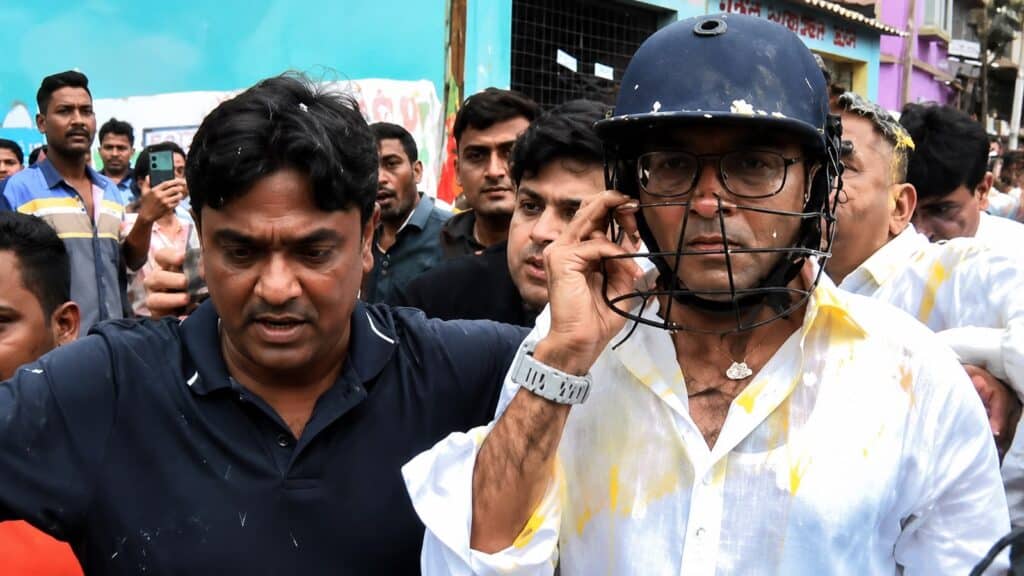
A political outreach programme by Trinamool Congress National General Secretary and MP Abhishek Banerjee descended into chaos in West Bengal’s Sonarpur on Saturday after his convoy came under attack during a visit to the family of a party worker whose death has become the latest flashpoint in the state’s post-poll violence debate. Stones, eggs and shoes were allegedly hurled at Banerjee’s convoy as protesters waved black flags and shouted slogans, forcing security personnel to form a protective shield around the senior TMC leader. Images from the scene showed Banerjee wearing a police helmet while being escorted through a hostile crowd, underlining the intensity of the confrontation.
The incident has triggered a fresh political battle between the Trinamool Congress and the Bharatiya Janata Party (BJP), with both sides accusing each other of exploiting violence for political gain. The confrontation occurred at a time when allegations of post-poll attacks, political intimidation and retaliatory violence continue to dominate political discourse in West Bengal following the Kaliganj Assembly bypoll. Banerjee’s visit was intended to express solidarity with the family of Sanju Karmakar, a TMC worker whose death has become the subject of competing political narratives. Instead, it evolved into one of the most significant political controversies in the state in recent months, raising fresh questions about law and order, political intolerance and the deepening polarisation of Bengal’s political landscape.
Why Abhishek Banerjee Travelled To Sonarpur
Abhishek Banerjee’s visit to Sonarpur was centred on meeting the family of Sanju Karmakar, a Trinamool Congress worker whose death has become a major political issue following the Kaliganj Assembly by-election. The TMC has alleged that Karmakar was killed in post-poll violence carried out by BJP-backed elements. The BJP has rejected those allegations and accused the ruling party of politicising the incident.
The Sonarpur visit was part of a broader programme under which Banerjee was also scheduled to meet the family of another deceased TMC worker, Biswajit Patnaik, in Kolkata’s Beleghata area. The Trinamool Congress presented both visits as an effort to stand beside families that had allegedly suffered because of political violence in the aftermath of the election.
The visit carried significance beyond the immediate issue of post-poll violence. It marked Banerjee’s first major public appearance in nearly a month following the Assembly election results and came at a politically sensitive moment for the ruling party. In recent weeks, the TMC leadership has faced sustained criticism from opposition parties over allegations of violence and political intimidation. Against that backdrop, Banerjee’s decision to personally meet the families of deceased party workers was intended to send a strong political message about the party’s commitment to its grassroots cadre.
Party leaders repeatedly described the visit as a humanitarian gesture rather than a political exercise. However, the high-profile nature of the programme ensured that it would be closely watched by both supporters and opponents.
Convoy Attacked As Tensions Explode
The confrontation began shortly after Banerjee entered Sonarpur, where groups of protesters had gathered along the route. Television footage and eyewitness accounts showed demonstrators waving black flags, shouting slogans and attempting to block the convoy’s movement.
As tensions escalated, stones, eggs and shoes were allegedly thrown at Banerjee and members of his entourage. Security personnel and police officers immediately moved to shield the TMC leader while attempting to secure his passage through the area. Visuals that emerged later showed Banerjee wearing a police helmet and moving through the crowd under heavy security protection.
The attack quickly became one of the most widely discussed political incidents of the day, with footage circulating across television channels and social media platforms. Several videos appeared to show a highly charged atmosphere, with security officials struggling to maintain order as protesters pressed toward the convoy.
Following the incident, Banerjee accused BJP-backed elements of carrying out a deliberate attack.
“They wanted to kill me,” he told reporters after the incident.
The TMC leader further alleged that a brick had struck near his eye during the attack and claimed that the violence was not spontaneous.
“A brick hit near my eye. Everything has been recorded. We will place the evidence before the appropriate authorities and the court if necessary,” he said.
His remarks immediately elevated the political significance of the incident, transforming it from a local confrontation into a state-wide controversy.
Banerjee Continues Visit Despite Security Concerns
One of the most notable aspects of the episode was Banerjee’s decision to continue with his programme despite the attack.
Reports indicated that local authorities had expressed concerns about possible unrest before the visit and had advised caution regarding the security arrangements. Political tensions in the area had already been high because of competing claims surrounding post-poll violence and the death of Sanju Karmakar.
The BJP had also publicly suggested that Banerjee could face hostility during the visit. BJP MLA Koustav Bagchi had stated before the programme that public anger against the TMC leadership could manifest itself during the visit, remarks that gained attention after the confrontation unfolded.
Despite the violence, Banerjee chose not to abandon the programme and proceeded to meet Karmakar’s family.
The Trinamool Congress later made that decision a central part of its political response. In a strongly worded statement, the party said Banerjee had remained committed to meeting the grieving family despite facing a violent attack.
“Even after a vicious attack, he refused to turn back and chose to stand beside a family devastated by an unimaginable loss,” the party said.
Images of Banerjee meeting family members after the attack were widely circulated by TMC leaders and supporters, who portrayed the visit as evidence of his determination to fulfil a commitment made to victims’ families regardless of political consequences.
For the ruling party, the fact that Banerjee completed the visit became as politically important as the attack itself.
Political Reactions Intensify Across Bengal
The political fallout was immediate and intense.
Abhishek Banerjee directly blamed BJP-backed activists for orchestrating the attack and questioned whether sufficient preventive measures had been taken despite advance knowledge of his visit.
“This was a planned attack. Those responsible wanted to create fear and stop us from meeting the family,” Banerjee said after the incident.
The Trinamool Congress subsequently escalated its criticism of the BJP’s state leadership. Party leaders accused the opposition of fostering a culture of political intimidation and violence. Several senior TMC figures argued that the attack demonstrated the increasingly confrontational nature of political competition in the state.
TMC MP Kalyan Banerjee also entered the debate, accusing sections of the law-enforcement machinery of unfairly targeting Trinamool workers while failing to adequately protect party supporters. He announced legal assistance for workers and families facing legal proceedings connected to post-poll violence cases.
The BJP firmly rejected all allegations of involvement in the attack. Opposition leaders argued that the protests reflected genuine public anger against the ruling party rather than a coordinated political operation.
The debate extended beyond the two principal parties. Leaders from the Left also weighed in, with CPI(M) youth leader Dipsita Dhar arguing that political leaders should stand beside workers in difficult times while simultaneously questioning whether such support had consistently reached grassroots workers across the political spectrum.
The competing narratives ensured that the Sonarpur incident quickly evolved into a wider political battle over accountability, victimhood and the nature of political violence in contemporary West Bengal.
A New Flashpoint In Bengal’s Post-Poll Violence Debate
The attack on Abhishek Banerjee has become far more than a security incident. It has emerged as a symbol of the larger struggle over how post-poll violence in West Bengal is interpreted, investigated and politically contested.
For years, allegations of political violence have followed elections across the state, with rival parties accusing one another of intimidation, targeted attacks and retaliatory action. The death of Sanju Karmakar has now become part of that wider debate, with the TMC presenting him as a victim of post-poll violence and the BJP disputing the ruling party’s claims.
The images from Sonarpur have added a new and highly visible dimension to that conflict. The sight of one of West Bengal’s most influential political leaders being escorted through a hostile crowd under police protection has become one of the defining political images of the post-election period.
For the Trinamool Congress, the episode represents evidence of a coordinated attack on a leader attempting to stand beside a bereaved family. For the BJP, the confrontation reflects growing public anger against the ruling establishment. Between those competing claims lies a deeper reality: political violence remains one of the most contentious and unresolved issues in West Bengal’s public life.
As investigations continue and political parties intensify their accusations, the events in Sonarpur are likely to remain at the centre of Bengal’s political conversation. What began as a visit to a grieving family has now become a defining moment in the state’s continuing battle over post-poll violence, political accountability and democratic dissent.


