

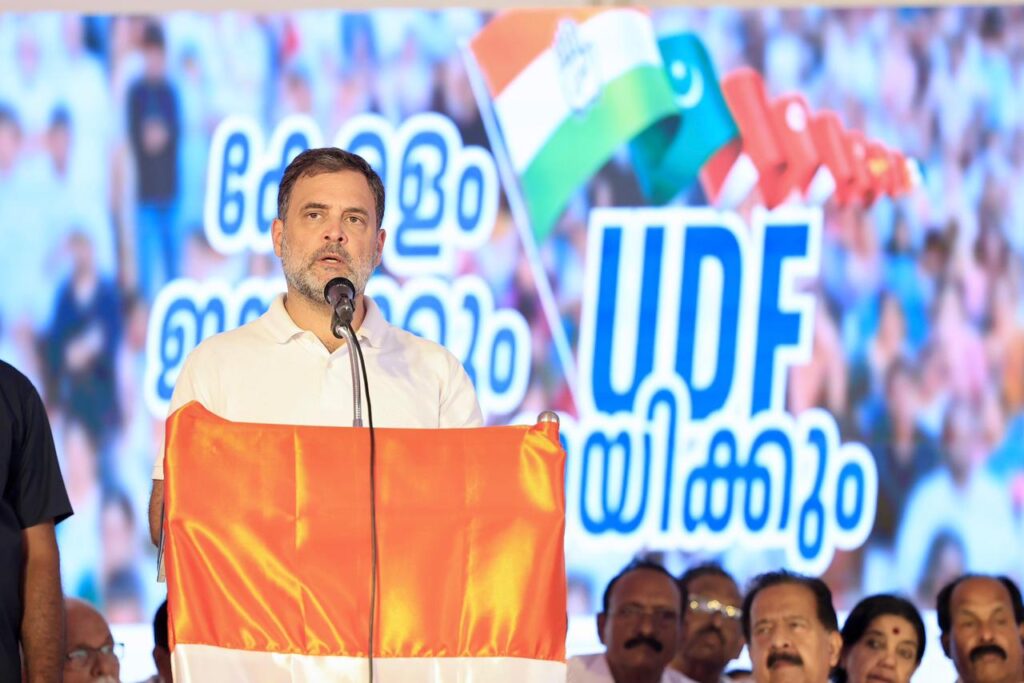
At multiple campaign rallies in Kerala, Leader of Opposition Rahul Gandhi placed the controversy surrounding the Sabarimala Ayyappa Temple at the centre of his political attack. Referring to reported irregularities flagged in late 2025, he alleged that gold linked to temple ornaments had been “taken and replaced with brass” in what he described as an organised operation.
The issue gained prominence after court observations pointed to discrepancies in gold plating on temple structures and idols, prompting the formation of a Special Investigation Team. Investigations led to arrests, including that of a priest, while legal proceedings remain ongoing and several accused have been granted bail. Authorities have not issued any final conclusion in the matter.
Gandhi questioned why Prime Minister Narendra Modi had not publicly addressed the controversy during his recent visit to Kerala. “The Prime Minister goes everywhere and speaks about temples and religion, but he has said nothing about Sabarimala,” he said. He further alleged that this silence was deliberate and politically motivated, suggesting it was intended to avoid causing discomfort to the ruling establishment in the state.
The BJP has rejected these claims, maintaining that due legal process is underway and that the party respects religious institutions and traditions.
BJP–LDF Nexus Allegation
Expanding his criticism beyond a single issue, Gandhi alleged that there is an implicit political understanding between the Bharatiya Janata Party and the ruling Left Democratic Front led by Pinarayi Vijayan. He argued that despite public rivalry, both sides avoid directly confronting each other on critical matters.
“This shows two things: the BJP and the LDF are working together,” Gandhi said, claiming that political silence on sensitive issues reflects a deeper alignment. He further stated, “We are contesting this election against the LDF, which is fully supported by the BJP,” framing the electoral contest as one between the Congress-led United Democratic Front and a combined political influence of its rivals.
According to Gandhi, the BJP does not consider the LDF a serious national challenger, while the Congress represents its primary ideological opposition. He suggested that this dynamic shapes political behaviour in Kerala, including what he described as selective attacks and strategic silence.
Both the BJP and the LDF have strongly denied these allegations, asserting that they are political adversaries with fundamentally different ideologies and policy positions.
Religion and Political Messaging
A significant part of Gandhi’s speech focused on what he described as selective use of religion in political discourse. He accused the Prime Minister of invoking religious themes when it suits electoral objectives while avoiding issues that could create political complications.
“Wherever he goes, he talks about temples and religion,” Gandhi said, adding that such references appear in nearly every major speech. However, he contrasted this with what he called a lack of response on the Sabarimala issue, arguing that this inconsistency raises questions about intent.
Gandhi went further, stating that religion is being used as a political tool rather than approached with consistency or sincerity. He suggested that the silence on Sabarimala reflects a calculated political decision rather than an oversight.
The BJP has consistently rejected accusations of politicising religion, stating that it is committed to respecting faith and cultural traditions while allowing legal processes to address disputes and controversies.
Jobs, Manufacturing and China Dependency
Shifting to economic concerns, Gandhi used a symbolic example to highlight what he described as structural weaknesses in India’s manufacturing sector. Holding up a microphone labelled “Made in China,” he questioned why such equipment is not produced domestically.
“The mic I am holding has ‘country of origin China’ written on it. Why does it not say ‘country of origin India’ or ‘state of origin Kerala’?” he asked. He linked this observation to broader concerns about employment, adding, “How will young people get jobs if we do not manufacture in India?”
Extending the argument to Kerala, Gandhi questioned how the state could build a strong industrial base if production remains limited and concentrated. He argued that reliance on imports directly affects job creation, particularly for young people entering the workforce.
Kerala’s economy, which relies heavily on services and remittances, faces challenges in generating large-scale employment within the state. Gandhi called for strengthening small and medium enterprises, reinforcing agriculture, improving infrastructure, and expanding the technology sector to create sustainable opportunities.
His remarks reflect a wider national debate on whether India’s growth model can deliver sufficient employment without a stronger manufacturing base and reduced dependence on imports.
Corporate Power and Governance Attack
Gandhi also reiterated his criticism of what he described as growing concentration of economic power. He alleged that the country’s economic direction is increasingly shaped by a small number of corporate groups, including those led by Gautam Adani and Mukesh Ambani.
“Your Chief Minister and the Prime Minister are handing this country over to Adani and Ambani,” he said, arguing that such concentration limits opportunities for smaller businesses and restricts broad-based job creation.
He also targeted the Kerala government, stating that a decade of LDF rule has weakened the state’s economic potential. Gandhi alleged that corruption cases involving LDF leaders have not been pursued effectively and that there has been no meaningful interrogation of key figures despite ongoing investigations.
The LDF has denied these allegations and maintains that it has focused on welfare, infrastructure, and inclusive development. The central government has also rejected claims of favouring specific corporate groups, stating that its policies are designed to promote investment and economic growth across sectors.
As Kerala approaches a crucial electoral phase, Gandhi’s remarks bring together economic concerns, governance issues, and political allegations, setting the stage for an intensified contest over development, accountability, and public trust.


