

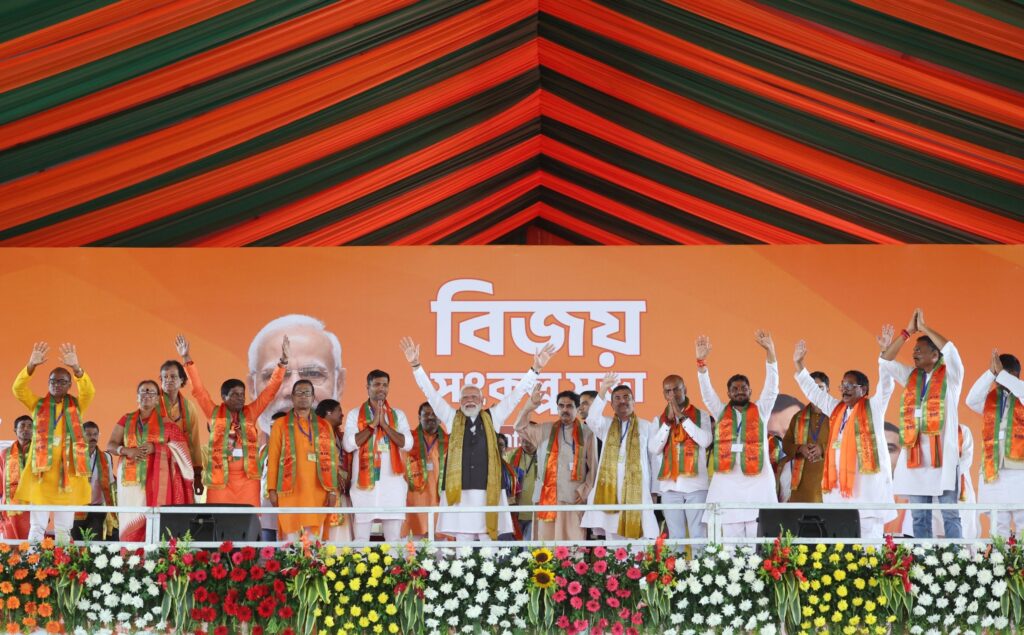
As West Bengal prepares for polling on April 23 and April 29 for its 294-member Assembly, Prime Minister Narendra Modi has intensified the Bharatiya Janata Party campaign by unveiling a structured “six guarantees” framework, positioning it as a roadmap for governance reform, economic revival and administrative accountability.
Announced during a major rally in Haldia and reinforced in subsequent addresses, including in Asansol, the guarantees have sharpened the contest with the ruling All India Trinamool Congress led by Chief Minister Mamata Banerjee. The election is increasingly being framed as a direct choice between competing governance models, with results scheduled to be declared on May 4.
Law and Accountability
A central theme of Modi’s campaign is the promise to restore institutional credibility and administrative transparency. In Haldia, he outlined his vision of an “accountable and fully answerable” government, stating that governance must be directly responsive to the people.
“I offer six guarantees to West Bengal,” he said, beginning with a commitment to replace what he described as an atmosphere of fear with trust and restore faith in the rule of law. He added that under a BJP government, “the administrative machinery will be accountable and fully answerable to the public it serves.”
This guarantee goes beyond rhetoric, incorporating promises of systemic reform, improved governance standards and reduced political interference in administration. It is designed to appeal to voters concerned about institutional decline and transparency in public functioning.
Justice and Security
A key component of the six guarantees focuses on reopening investigations into major criminal and corruption-related cases. Modi stated, “The files regarding every scam, every act of corruption, every injustice committed against our daughters, and every case of rape will be reopened.”
He reinforced this message with a strong assurance on women’s safety and justice, saying, “Those who have committed crimes against our mothers and sisters will not be spared.”
By linking justice with governance reform, the BJP is attempting to position the election as a turning point for accountability and security. The emphasis on reopening cases also signals a broader intent to revisit past administrative decisions under a potential new government.
Corruption Crackdown
Corruption remains one of the sharpest attack points in the BJP’s campaign. Modi declared that individuals involved in corruption would face strict consequences, stating, “Under the TMC’s rule, whoever has engaged in corruption belongs in jail.”
He added a strong and inclusive warning: “Be it a minister or a watchman, the law will hold everyone to account. No one will be able to evade the law any longer.”
This forms the fourth guarantee and reflects the BJP’s broader narrative of dismantling entrenched corruption networks. The messaging is aimed at reinforcing the idea of equal accountability under the law, while appealing to voters frustrated with alleged corruption in governance systems.
Identity and Citizenship
Identity politics continues to be a defining feature of the Bengal election. Modi reiterated a dual-position approach, stating, “Refugees will be granted every right and privilege guaranteed by the Constitution. However, infiltrators will be driven out.”
This guarantee aligns with the BJP’s broader national stance on citizenship and migration. In a state with complex demographic dynamics, the issue carries significant political weight.
The framing seeks to draw a distinction between humanitarian protection and national security concerns, while also consolidating support among voter groups sensitive to these issues. The ruling All India Trinamool Congress has strongly opposed this narrative, arguing that it risks social division.
Economy and Development
Economic revival and employment generation form a core part of Modi’s campaign messaging. Criticising prolonged industrial decline, he said in Asansol, “This election is not just about changing the government. This is an election to restore industrial strength and break free from mafia rule.”
He argued that only a BJP-led government could revive industry and unlock economic potential in key regions. The reference to “mafia rule” reflects the BJP’s broader critique of local power structures allegedly affecting investment and growth.
Modi also emphasised the concept of a “double engine government,” stating that alignment between the Centre and the state would accelerate development. “The people benefit the most when the Prime Minister and the Chief Minister work together,” he said, adding that such coordination is essential for faster progress.
Highlighting sector-specific development, he noted that the Union government had created a dedicated Ministry of Fisheries, expanded financial support, and provided fishermen with access to Kisan Credit Cards and insurance coverage of up to Rs 5 lakh. These measures, he suggested, could help make Bengal self-reliant in fisheries and seafood production.
Pay, Welfare and Political Contest
The sixth guarantee focuses on financial reform through the implementation of the Seventh Pay Commission. Modi stated, “The moment a BJP government is formed here, we will implement the 7th Pay Commission,” directly targeting government employees and their families.
Beyond policy promises, Modi also delivered a broader political message, stating, “People no longer want to rely on mere words; they want to judge based on actions and track records.” He argued that the BJP offers the strongest development record and positioned the party as the most credible alternative.
He further asserted, “After May 4, every single problem in this area will be resolved by our government,” projecting confidence in electoral success.
Meanwhile, the All India Trinamool Congress has mounted a strong counter-campaign. A major controversy has emerged over a sting video allegedly involving a BJP-linked figure discussing strategies to influence voting patterns. The BJP has dismissed the video as a deepfake, accusing the TMC of misinformation.
Chief Minister Mamata Banerjee has responded by highlighting her government’s welfare programmes and positioning the TMC as a defender of social harmony and regional identity.
Election Outlook
The West Bengal Assembly election has evolved into a sharply contested political battle, defined by competing narratives of governance, identity and economic development. Narendra Modi’s six guarantees provide a structured and detailed campaign framework, combining administrative reform, economic promises and political messaging.
At the same time, Mamata Banerjee and the TMC continue to defend their record while challenging the BJP’s claims, ensuring a highly competitive electoral environment. With voting scheduled across two phases and counting on May 4, the outcome will depend on how effectively these narratives resonate with voters across the state.


