

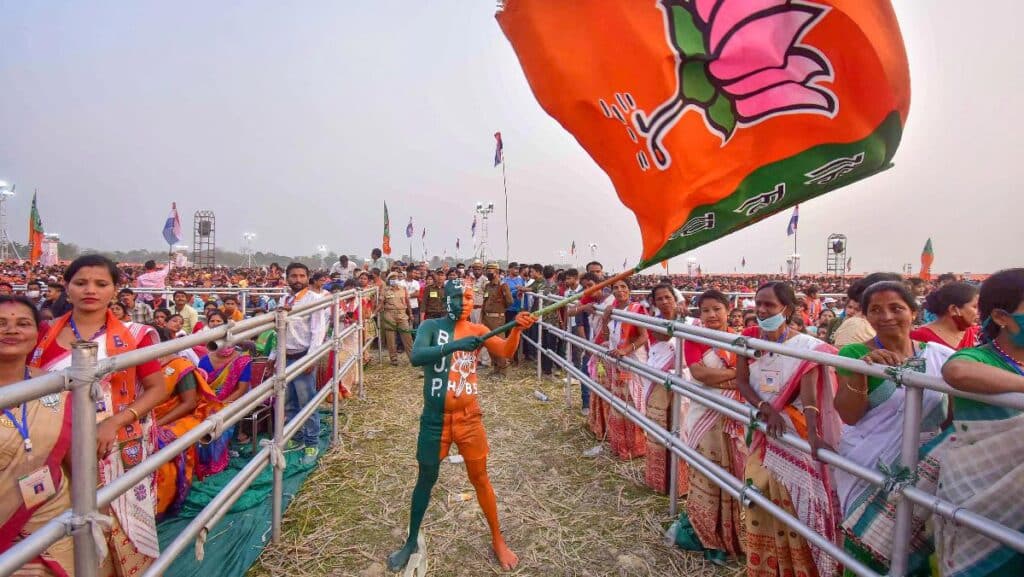
Even before the first Electronic Voting Machine is opened on counting day, the Bharatiya Janata Party’s state headquarters in Guwahati has moved into preparation mode for a possible victory celebration. Party workers were seen arranging decorations, organising logistics and preparing for the arrival of leaders and supporters ahead of the official declaration of results. The scenes underline the confidence within the BJP camp as Assam prepares for one of its most closely watched political verdicts in recent years.
The Assam Assembly result carries significance far beyond the state capital. For the BJP, Assam remains its strongest political base in the Northeast and a critical pillar of its long-term expansion strategy in eastern India. For the opposition, particularly the Congress and its allies, the result is an opportunity to test whether anti-incumbency and local dissatisfaction can translate into a serious electoral challenge. With counting scheduled to begin on May 4, the verdict will shape not only the future government in Dispur but also the wider national political narrative.
BJP Signals Confidence Before Counting
Preparations at the BJP office in Guwahati began before a single vote had been counted, a move widely interpreted as a sign of internal confidence. Party workers gathered at the headquarters to coordinate celebrations, while senior functionaries remained in close contact with district-level teams.
Political parties often avoid visible celebration planning before counting in order to prevent accusations of overconfidence. In this case, however, the BJP appears eager to project certainty and momentum. The message is aimed at supporters as much as opponents: the party believes it has secured another mandate.
Chief Minister Himanta Biswa Sarma has repeatedly expressed confidence during the campaign. “The people of Assam have supported development, stability and progress,” he said during recent public appearances. While such remarks are standard during election season, they reflect the BJP’s strategy of framing the contest around governance and continuity.
Within the party, leaders believe welfare schemes, road connectivity projects, flood management promises and law-and-order messaging have helped maintain support across key constituencies. The visible preparations in Guwahati therefore represent more than symbolism; they are part of a carefully managed political signal ahead of counting day.
Why Assam Is Politically Crucial
Assam is not just another state election. It is the political gateway to the Northeast and the BJP’s most influential state in the region. Since coming to power in Assam, the BJP has used the state as an organisational and strategic base to expand its presence across neighbouring northeastern states.
A fresh mandate would strengthen the party’s claim that it has transformed from an outsider force into the dominant political power in Assam. It would also reinforce the BJP’s broader narrative that regional aspirations and national governance can coexist under its leadership.
For the Congress, the stakes are equally high. Once the principal political force in Assam, the party has been trying to rebuild support through alliances, local outreach and criticism of the state government’s handling of unemployment, inflation and social tensions.
Congress leaders have insisted the contest remains competitive. “We are confident that the people have voted for change,” opposition representatives said while urging counting agents to remain alert at centres across the state.
The result is therefore about more than seat numbers. It is a test of whether the BJP can sustain long-term incumbency in a politically diverse state, and whether the opposition can convert criticism into electoral recovery.
Himanta Biswa Sarma at the Centre of the Contest
Much of the election campaign has revolved around Chief Minister Himanta Biswa Sarma, who remains the BJP’s most prominent face in Assam. His leadership style, direct communication approach and high-profile campaigning have made him central to the party’s electoral strategy.
Supporters credit Sarma with accelerating infrastructure works, improving administrative visibility and strengthening the BJP’s grassroots network. Critics, however, argue that unemployment, rising prices and local grievances remain unresolved.
Sarma has consistently defended his government’s record. “Our work speaks for itself. The people of Assam know what has changed in the last few years,” he said during campaign rallies.
If the BJP secures a comfortable majority, the result is likely to be interpreted as a personal endorsement of Sarma’s leadership. If margins narrow, analysts may view it as a sign that the state remains competitive despite the BJP’s organisational advantage.
His role also matters nationally. Within the BJP, Sarma is regarded as one of the party’s most effective regional leaders, and a strong result in Assam would further enhance his standing.
Counting Day Tension and Opposition Pushback
Counting is expected to begin with postal ballots before Electronic Voting Machine rounds start. Early leads often create headlines, but experienced election observers caution that trends can shift significantly as later rounds are completed.
Security arrangements have been tightened at counting centres, with officials, observers and authorised party agents expected to monitor each stage of the process. Strongroom security and transportation protocols have also remained under close scrutiny in the final hours before counting.
Opposition parties have urged workers to stay vigilant throughout the day. Congress leaders said every round must be carefully monitored and every vote accurately recorded. “Our workers should remain present until the final result is declared,” party representatives said.
Such statements reflect a familiar election-day reality in India: confidence before counting often coexists with anxiety inside party camps. Even small swings in closely fought seats can alter the final picture.
The BJP, meanwhile, has attempted to project calm confidence, believing its organisational machinery and voter outreach have created a clear edge.
What the Verdict Could Mean
If the BJP-led alliance returns to power, it would mark another major milestone in the party’s consolidation of Assam politics. It would demonstrate that the BJP can retain voter trust beyond first-term enthusiasm and continue governing in a complex regional landscape.
A renewed mandate would also strengthen the party’s claim of sustained influence in eastern and northeastern India, areas once considered difficult terrain for the BJP.
If the result is tighter than expected, however, it could give the opposition a psychological boost and suggest that anti-incumbency remains a powerful force. Even a reduced majority would change the political reading of the verdict.
For Assam itself, the election outcome will determine the direction of governance on issues such as jobs, development, flood preparedness, identity politics and regional investment over the coming years.
Tonight, the BJP office in Guwahati is preparing for celebration. Tomorrow, Assam’s voters will decide whether that confidence was justified. The numbers, not the decorations, will deliver the final verdict.


