

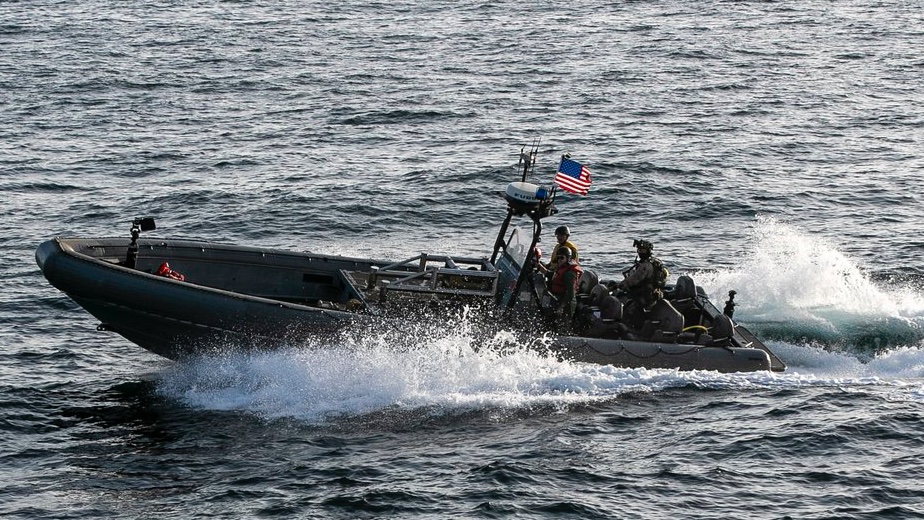
United States forces have boarded a tanker linked to Iran as part of an expanding maritime crackdown, with the Pentagon confirming that the operation was carried out without incident in the Indo-Pacific. The vessel, identified as the M/T Tifani, was described by US officials as a stateless tanker previously sanctioned for transporting Iranian crude, a designation that carries significant legal implications under international law.
According to the Department of Defense, the operation involved a “right-of-visit, maritime interdiction and boarding” conducted in international waters. The tanker had been under scrutiny for its suspected role in facilitating shipments through covert networks designed to bypass sanctions. Officials said the interception was executed in line with established legal frameworks governing maritime enforcement, allowing naval forces to stop and inspect vessels suspected of illicit activity.
The classification of the tanker as stateless is central to the operation. Such vessels are not registered under any national flag and therefore lack the protections typically afforded under maritime law. This status enables enforcement actions with fewer diplomatic constraints, particularly when combined with prior sanctions designations.
US authorities said the boarding was precise and controlled, with no injuries reported. The incident underscores Washington’s growing capacity to track and interdict vessels across vast distances, extending enforcement well beyond traditional areas of focus in the Gulf region.
Global enforcement expands
The boarding reflects a broader shift in US policy towards what officials have described as a global maritime enforcement campaign targeting networks that support Iran’s oil exports. The Pentagon has made clear that such operations are not confined to specific regions but are intended to be carried out wherever sanctioned vessels are identified.
In a strongly worded statement, defence officials emphasised the scope of this approach, stating that enforcement efforts would continue against illicit shipping networks regardless of location. “International waters are not a refuge for sanctioned vessels,” the statement said, underscoring Washington’s position that maritime law does not shield those engaged in sanctioned activity.
The expansion of enforcement into the Indo-Pacific highlights the scale of surveillance and tracking capabilities being deployed. Vessels suspected of involvement in Iran’s oil trade are monitored across multiple regions, often over extended periods, before action is taken.
This strategy is closely tied to broader efforts to limit Iran’s ability to generate revenue through energy exports. Oil remains a critical component of Tehran’s economy, and disrupting the logistics of its transport has become a central focus of US policy. By targeting the vessels themselves, rather than solely the transactions, Washington is seeking to apply pressure directly within the maritime domain.
Tactics grow more assertive
Recent operations suggest a marked evolution in how maritime enforcement is being conducted. While earlier approaches often relied on compliance and voluntary inspections, there has been an increasing willingness to take direct action when vessels fail to respond to warnings.
In a related incident, a ship linked to Iran was disabled after ignoring repeated communication attempts before being boarded by US forces. Officials indicated that such measures are considered when vessels demonstrate clear intent to evade oversight, particularly in cases involving suspected sanctions violations.
The Pentagon has also raised concerns about the nature of cargo carried by some of these vessels. Certain shipments are believed to include materials classified as dual-use, meaning they could serve both civilian and military purposes. While specific cargo details are not always disclosed, such classifications heighten the strategic importance of interdictions.
The evolving posture reflects a broader operational doctrine. In its statement, the Department of Defense said it would continue to “deny illicit actors and their vessels freedom of maneuver in the maritime domain,” signalling a shift towards more proactive control of contested shipping routes.
This approach places greater emphasis on deterrence, with enforcement actions designed not only to intercept individual vessels but also to discourage wider participation in sanctioned networks.
Iran condemns operation
Iran has strongly criticised the boarding of vessels linked to its oil trade, describing such actions as unlawful interference in civilian maritime activity. Officials in Tehran have argued that the targeted ships are engaged in legitimate commerce and that their interception violates established norms governing international navigation.
The response reflects broader tensions surrounding maritime security and the enforcement of sanctions, particularly as operations expand beyond the Middle East into global shipping lanes. Iranian authorities have also raised concerns about the safety of crews aboard intercepted vessels, noting that many are civilian mariners operating under increasingly uncertain conditions.
US President Donald Trump defended the operation, framing it as a necessary step in enforcing long-standing restrictions. “These ships have been involved in serious violations for years, and we are not going to let that continue,” he said, reinforcing Washington’s stance that such actions are justified under international law.
The exchange of statements highlights the deep divide between the two sides, with each presenting sharply contrasting interpretations of legality and intent. As enforcement continues, diplomatic tensions remain closely tied to developments at sea.
Global risks rise
The interception of the M/T Tifani comes amid heightened sensitivity in global energy markets and increasing scrutiny of key maritime corridors. The movement of oil through international waters remains critical to global supply chains, and enforcement actions of this nature have drawn attention from governments and industry alike.
The presence of naval forces in major shipping lanes has contributed to a more cautious operating environment for commercial vessels. Shipping companies are closely monitoring developments, aware that increased enforcement activity can introduce additional uncertainty into already complex logistical operations.
The situation also carries broader geopolitical implications. As enforcement expands geographically, it intersects with major trade routes used by multiple countries, raising the stakes of any potential miscalculation. The continued boarding and interception of vessels linked to Iran adds to an evolving maritime landscape shaped by economic pressure, legal enforcement, and strategic competition.
The Pentagon’s emphasis on global reach and sustained action suggests that such operations are likely to remain a defining feature of current tensions. The boarding of a stateless, sanctioned tanker in international waters stands as a clear indication of how enforcement at sea is becoming central to the wider confrontation surrounding Iran’s oil trade.


