

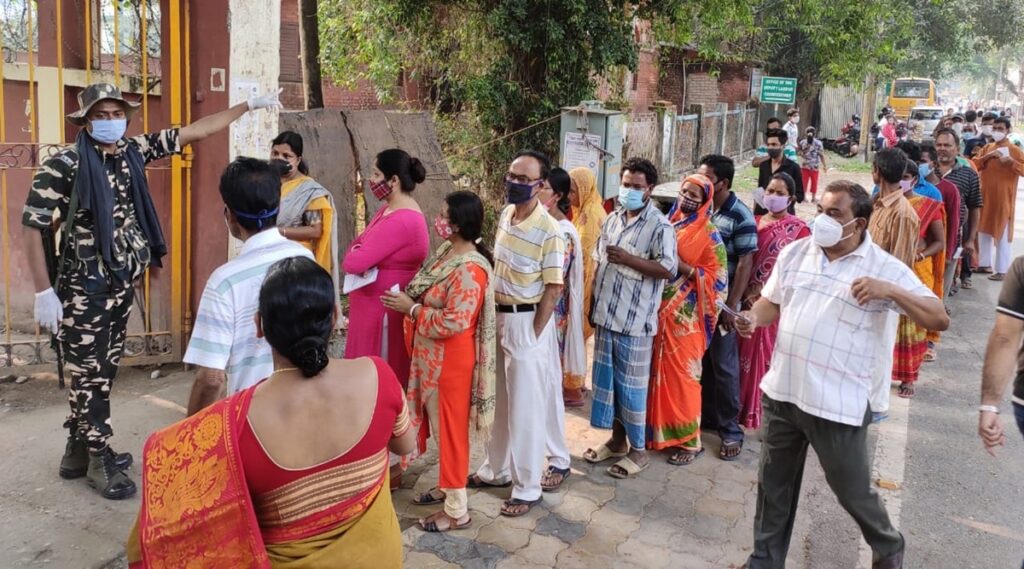
The first phase of the 2026 West Bengal Assembly election recorded a sharp surge in voter participation, underlining the intensity of the contest. Voting was held across 152 constituencies spanning North Bengal, Murshidabad, Paschim Medinipur, Jhargram, and the Asansol-Durgapur industrial belt, all of which are considered politically decisive regions.
Polling began early and maintained steady momentum throughout the day. Election officials reported turnout of nearly 20 percent within the first two hours, rising to over 40 percent by late morning and crossing 60 percent by early afternoon. By the close of polling, turnout had climbed to nearly 90 percent, with official estimates placing it at approximately 89.93 percent.
The Election Commission described the turnout as “encouraging and reflective of strong democratic participation.” Over 3.6 crore voters were eligible in this phase, with more than 1,400 candidates contesting, highlighting the scale of the exercise.
Analysts note that such high turnout in West Bengal often reflects both strong political mobilisation and a deeply competitive environment. Several key constituencies in this phase are considered strategically important, with nearly 59 seats expected to significantly influence the broader electoral outcome.
Violence and security concerns
Despite the high turnout, the voting process was marked by incidents of violence and confrontation in multiple districts. Reports from Murshidabad, parts of North Bengal, and the Asansol industrial belt indicated clashes between rival political workers, allegations of intimidation, and isolated incidents involving crude explosives.
Tensions were already high in Murshidabad, where a crude bomb was reportedly hurled on the eve of polling, raising concerns about preparedness in sensitive areas. On polling day, specific incidents included the vandalism of a candidate’s vehicle in Asansol and reports of assaults in parts of Dinajpur. In some locations, political workers were chased away from polling stations, adding to the atmosphere of uncertainty.
The Election Commission acknowledged receiving complaints but stated that security forces acted swiftly. “We have taken immediate action wherever disturbances were reported. Polling has continued with necessary safeguards,” an official said.
Security deployment was extensive. Authorities stationed large numbers of central paramilitary forces across vulnerable constituencies. More than 8,000 polling booths had been identified as “super-sensitive,” requiring heightened monitoring and additional security presence.
In the days leading up to voting, authorities also carried out a preventive crackdown, detaining nearly 200 individuals in an effort to reduce the risk of violence. Despite these measures, recurring incidents have once again raised questions about electoral security in high-stakes contests.
EVM issues and disruptions
Technical disruptions were reported in several polling stations, primarily related to Electronic Voting Machines. In some constituencies, voting was temporarily halted due to machine malfunctions, leading to delays and long queues.
Election officials confirmed that technical teams were deployed to affected areas and that faulty machines were replaced promptly. “Wherever EVM issues were reported, replacement procedures were initiated immediately to minimise inconvenience to voters,” an official stated.
While most disruptions were resolved within a short time, the incidents caused frustration among voters and added to concerns about operational efficiency. In tightly contested elections, even brief interruptions can influence public perception of the electoral process.
Experts note that while EVMs remain a core component of India’s voting system, repeated reports of malfunction during high-profile elections often become a focal point of political debate. The Election Commission has maintained that the integrity of the process remains intact.
Voter roll controversy
The revision of voter rolls has emerged as one of the most contentious aspects of the 2026 election. A large number of voters were placed under scrutiny during the verification process, with only a limited number reinstated after review.
Election authorities maintain that the exercise was conducted to remove duplicate and ineligible entries. “The revision process is a standard procedure to maintain accuracy in voter lists,” an Election Commission representative said.
However, opposition parties, including the ruling Trinamool Congress, have strongly criticised the process, alleging that it may have led to the exclusion of legitimate voters. Concerns over missing names in electoral rolls shaped early voter sentiment in several constituencies, with some voters reporting that they were unable to find their names on polling lists.
Reports also indicate a noticeable decline in the overall voter base compared to previous elections, intensifying the debate around disenfranchisement. Civil society groups have raised concerns that even limited exclusions can affect public trust in the system.
The issue has shifted the political narrative beyond traditional campaign themes, placing electoral fairness and voter inclusion at the centre of the debate.
Leadership and key issues
The election is being defined by a high-profile contest between Chief Minister Mamata Banerjee and the Bharatiya Janata Party’s leadership. The Trinamool Congress is seeking to retain power after more than a decade in office, while the BJP is aiming to expand its presence in a state that remains politically significant at the national level.
Key contests in this phase include prominent leaders such as Suvendu Adhikari, Dilip Ghosh, and Humayun Kabir, reflecting the importance of the constituencies voting in the opening round.
Mamata Banerjee has focused her campaign on welfare programmes and regional identity, highlighting schemes aimed at women, rural communities, and economically weaker sections. Her party maintains that these initiatives have delivered measurable benefits.
The BJP, led nationally by Prime Minister Narendra Modi and Home Minister Amit Shah, has centred its campaign on governance, development, and allegations of corruption. The party has also emphasised employment, infrastructure, and law and order.
Economic concerns remain central to voter sentiment. Issues such as unemployment, migration of young workers, and limited industrial growth continue to dominate public discussion. At the same time, debates around identity, citizenship, and demographic change have contributed to political polarisation in several regions.
With the next phase of voting scheduled for April 29 and results expected on May 4, the election remains closely contested. Analysts suggest that the outcome will depend on turnout patterns, regional dynamics, and how effectively parties address voter concerns in the remaining phases.


