

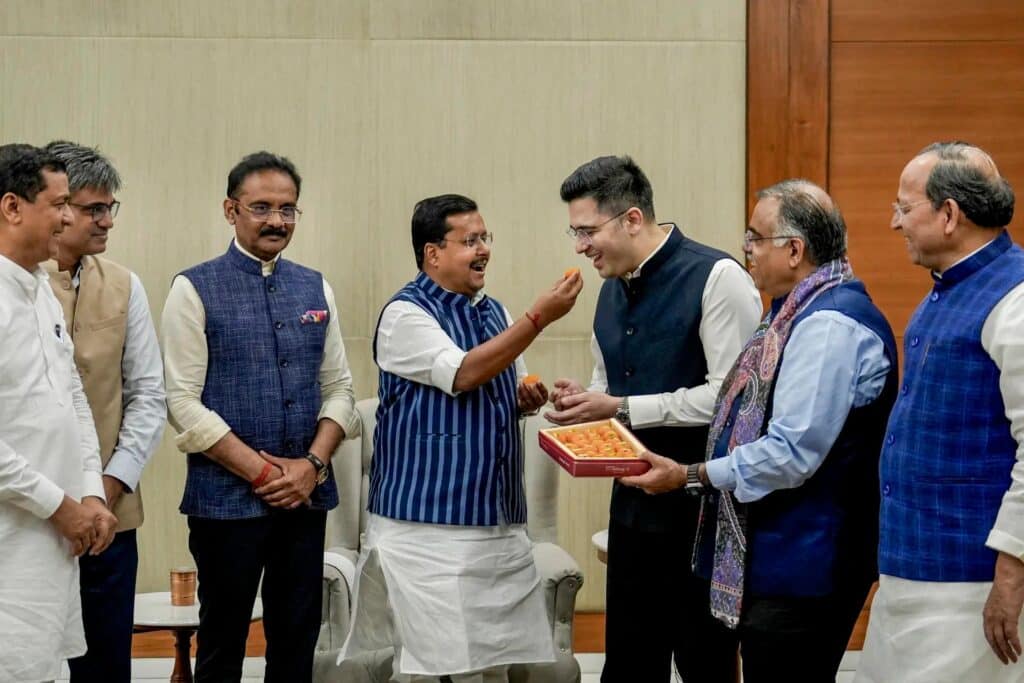
In a major political development with immediate implications for India’s parliamentary balance, Raghav Chadha has led a coordinated split within the Aam Aadmi Party (AAP) in the Rajya Sabha and joined the Bharatiya Janata Party (BJP), along with a significant group of party MPs.
At a joint press interaction alongside fellow MPs including Sandeep Pathak and Ashok Mittal, Chadha formally announced that two-thirds of AAP’s Rajya Sabha members had decided to merge with the BJP. The move, if recognised, would mark one of the most substantial parliamentary realignments involving AAP since its formation and significantly alter the party’s presence in the Upper House.
According to reports, at least seven of AAP’s ten Rajya Sabha MPs have backed the decision and submitted formal merger documents to the Rajya Sabha Secretariat. The development comes at a politically sensitive time, as opposition parties attempt to consolidate ahead of upcoming elections, and is widely seen as a major setback to AAP’s national ambitions.
Merger Under Law
The transition has been structured under the Tenth Schedule of the Constitution, which governs the anti-defection law. This provision allows legislators to avoid disqualification if at least two-thirds of a party’s members agree to merge with another political party.
In this case, the group led by Chadha appears to have crossed that threshold. By framing the move as a formal merger rather than individual defections, the MPs have sought to remain within the constitutional framework while shifting political allegiance.
Those reported to be part of the move include Ashok Mittal, Sandeep Pathak, Swati Maliwal and Harbhajan Singh, among others. Many of these MPs are linked to Punjab, a state where AAP has a significant political presence, adding a regional dimension to the development.
If the merger is accepted by the Rajya Sabha Chairman, AAP’s strength in the Upper House could drop to just three MPs, sharply reducing its legislative influence. At the same time, the BJP’s position would be strengthened, improving its ability to navigate key legislative processes.
The coordinated nature of the move, along with its legal framing, indicates a carefully planned political strategy rather than a sudden or isolated decision.
Chadha’s Exit and Position
Explaining his decision, Chadha said the move was rooted in ideological differences and not political expediency. He stated that the party he once believed in had “moved away from its founding principles of transparency and clean governance,” marking a clear break with AAP’s current direction.
He also remarked that he increasingly felt he was “the right person in the wrong party,” reflecting the depth of his divergence with the party leadership.
At the same time, Chadha expressed confidence in the leadership of Narendra Modi, saying he had chosen to align with a political platform that offered “clarity, stability and a strong vision for the country.”
Emphasising that the decision was not individual, Chadha said the move had been taken collectively, noting that “two-thirds of AAP’s Rajya Sabha MPs” had acted together. This framing reinforces both the scale of the split and its legal grounding under the anti-defection law.
His exit follows months of visible distancing from AAP. He had remained absent during key political developments and was removed from a leadership role within the party’s Rajya Sabha structure. These developments had led to speculation about internal differences, which have now culminated in a formal split.
AAP Hits Back
The response from Arvind Kejriwal and AAP leadership has been immediate and sharply worded. Kejriwal said, “BJP has again betrayed Punjab,” linking the development to the party’s political base in the state.
Senior AAP leaders also criticised Chadha directly, with one leader stating that the party had “given everything to Raghav Chadha, and he has ended up in BJP’s lap.” The remarks reflect both political anger and a sense of internal betrayal.
AAP has accused the BJP of attempting to weaken opposition parties by encouraging such splits. While no direct evidence has been presented publicly, the accusation forms part of the broader political confrontation surrounding the development.
The party is also examining possible legal options, although the reported numbers suggest the merger may meet the constitutional threshold required to avoid disqualification. Internally, AAP faces the immediate challenge of reorganising its parliamentary leadership and maintaining its presence in the Rajya Sabha with significantly reduced numbers.
BJP Gains Numbers
For the BJP, the development represents both a numerical and strategic gain. The addition of multiple MPs strengthens its position in the Rajya Sabha, where numbers are critical for passing legislation.
Chadha’s entry brings a parliamentarian with experience in policy debates and strong communication skills. His ability to articulate positions on governance and economic issues is seen as an asset that could strengthen the party’s parliamentary presence.
He joined the BJP in the presence of senior leaders, underlining the formal and coordinated nature of the move. While no official role has been announced, there is speculation that he could be considered for a larger responsibility after a period of integration.
Beyond numbers, the development also weakens a competing political force, giving the BJP both legislative advantage and political momentum.
Political Impact Ahead
The immediate impact of the development is visible in the changing composition of the Rajya Sabha, but its broader implications extend across India’s political landscape. AAP’s reduced strength weakens its ability to influence national legislation and raises questions about its organisational stability.
The episode also highlights the challenges facing opposition parties in maintaining unity. At a time when efforts are underway to build coordinated strategies against the BJP, such internal splits underline the fragility of political alliances.
The use of the anti-defection law’s merger provision demonstrates how constitutional mechanisms can shape political outcomes. By acting collectively, legislators are able to navigate legal constraints while significantly altering political alignments.
In the coming days, attention will focus on the Rajya Sabha Chairman’s decision on the merger, AAP’s next steps, and whether similar developments emerge in other parties. As India moves closer to key elections, the episode is likely to remain central to political discourse, reflecting the evolving dynamics of power within the country’s parliamentary system.


